Table of Contents
As the U.S. gears up for potential strikes, exploring how the West misunderstands Iran is more important than ever. In this interview, Abbas Milani, Director of Iranian Studies, reflects on the Islamic Revolutionary Guard Corps (IRGC), Iran’s increasing secularization, and Reza Pahlavi’s political future.
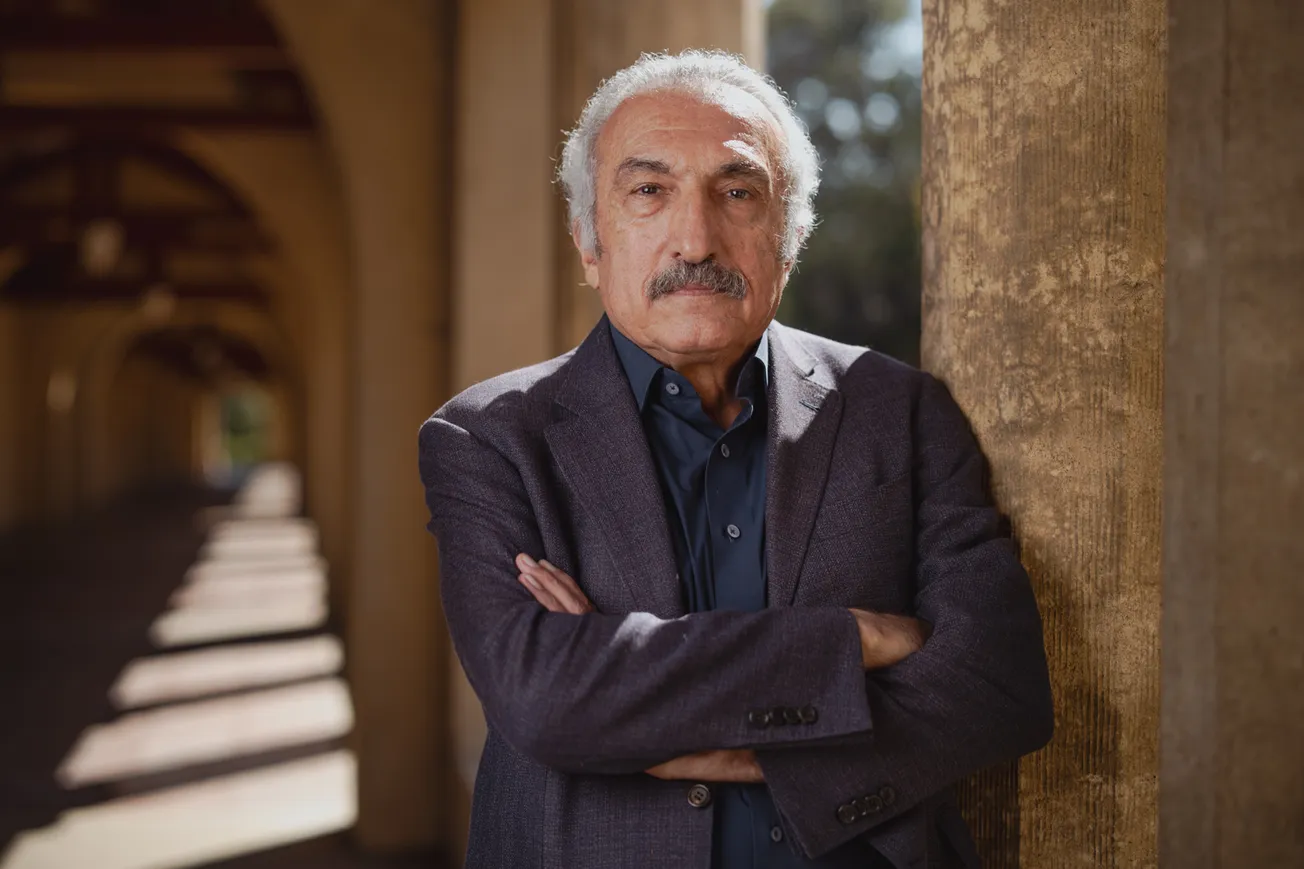
Professor Abbas Milani is the Director of Iranian Studies at Stanford University, a Professor of Stanford Global Studies, and a research fellow at the Hoover Institution, where he is also a founding co-director of the Iran Democracy Project. Before Stanford, he taught at Tehran University’s Faculty of Law and Political Science until 1986, chaired the Political Science Department at Notre Dame de Namur University for 14 years, and served as a visiting research fellow at UC Berkeley’s Middle East Center for eight years. He has published more than 20 books and 250 articles and reviews.
Bassel Ojjeh: You’re the Hamid and Christina Moghadam Director of Iranian Studies at Stanford University and a founding co-director of the Iran Democracy Project at the Hoover Institution. In one sentence: What does the West misunderstand most about Iran?
Abbas Milani: It greatly misunderstands Iran because it thinks Iranian society is the same as the Iranian regime.
Ojjeh: Today, and historically?
Milani: Historically, too. They also think Iran is the same or part of the same mix as the Middle East.
Iranian society today has a very difficult relationship with the regime. And Iranian society in the Middle East has some unique characteristics. Mixing them is a historical mistake.
Ojjeh: I see. You mentioned how Iran and the Middle East cannot be mixed. They are two distinct entities…
Milani: More than two. Several different entities.
Ojjeh: So, when Americans associate Iran with “Islam”, “Shiism”, “Sanctions”, or “Nuclear” – in your definition of what Iran is, are these words part of the true essence of Iran, or are they just what make it Iran today?
Milani: I think it absolutely misses what Iran is. To reduce Iran to those categories is to confuse the most recent manifestation of a malignant state, which I think the Islamic Republic is for Iran, with the essence of Iran.
If we’re talking about the essence of a culture, then by some accounts, it is 12,000 years old. There are detailed accounts of major urban centers in the broader plateau that go back that far. Iran has at least 3,000 years of recorded history of being called Iran. It’s where Zoroastrianism, arguably the first monotheistic religion in the world, developed. I've learned from other scholars that the Abrahamic religions would not have been imaginable without Zoroastrianism.
Iran has given the world architecture, including what many call Islamic architecture. In the Middle East, much of it is a reconfiguration of Iranian architecture. Baghdad's circular structure clearly derives from the ideal type of an urban city found in the Sassanid Empire, for example.
To lump all of that into Islamic Iran, Shiite Iran — or as many Americans would say, the Arabic world — or an Islamic world — misses the complexity of Islam and Iran.
Ojjeh: So, on this topic of American influence and American perspective on Iran, when we hear Americans say “the Iranian people want freedom,” what does “freedom” mean in Iran and for Iranians? What does it mean to you?
Milani: I tried to develop my definition based on experience, on what’s possible for Iran, and on what Iranians want. My sense is that the great majority of Iranian people now, with reliable polling indicating nearly ninety percent of them, don't want to live under this regime. They don’t want a theocracy. They want a secular government. They are more respectful of religious plurality than the regime is.
For me, and increasingly for many in Iran, freedom means you are free to choose your faith. Free to change your faith. If you decide you don’t want to be Muslim, if you want to be Zoroastrian, or Baha’i, or a heretic, that is your right.
It also means equality. There is good evidence that the majority of Iranians want there to be no difference between a woman and a man.
Ojjeh: Okay, very interesting! With that being said, I’m going to be playing devil’s advocate here: if the regime fell today, why wouldn’t Iran become “Syria 2.0” only worse?
Milani: First of all, Syria became Syria not only because of internal dynamics. It became Syria because of a murderous regime called the Assad family. They ruled with an iron fist and were propped up for decades by the Soviets. But once the conflict began, many forces opposed a unified Syria. Iran pulled one way; Russia pulled the other way; the Israelis pulled another way; the Saudis pulled another way; the French and Europeans pulled the other way. Turkey pushed its own agenda. The Kurds pushed another way. Many were willing to put money and boots on the ground to carve out their piece of land.
I don’t think Iran will share that fate unless those forces intervene.
Ojjeh: Why wouldn't these forces come? Iran has an incredible amount of resources.
Milani: Most of these countries would have more to lose from a chaotic Iran than a stable one. The migration that was brought about by the civil war in Syria disrupted Europe. And it's going to have a long-term impact.
Nobody has really thought about what the existence of all the Muslims in Europe means in terms of their integration into a liberal democratic society.
Unlike Syria, Iran has a very nimble civil society that has fought for democracy for all of these years now. But what makes the danger possible is that Iran has ethnicities that are disgruntled. Kurds, Azeris, and Baluchis present the potential for fragmentation.
Ojjeh: What about the IRGC? Could they become “ISIS 2.0”?
Milani: There’s no evidence that the IRGC is still primarily an ideological radical group. Every indication is that the IRGC is a corrupt military, with almost a 40% share of the entire economy.
Ojjeh: Wow. That’s a massive amount.
Milani: If you follow Iranian events closely, you will see stories of commanders taking over banks and running them into bankruptcy. You see networks tied into massive construction and real estate. This is not a force with an ideological stake first. It has a financial stake.
Ojjeh: So you don't see a potential for the IRGC or other groups to become a radical anti-Western division in a civil war scenario?
Milani: Of course it's possible. But groups like ISIS don’t develop in a vacuum. They need context. Saddam's brutalities, for example, gave context. And then you had a lot of money coming from a lot of different groups that wanted ISIS strengthened because they thought Iran was helping Hezbollah, and Saudi Arabia needed to support its version of Hezbollah. They need a radical Sunni to fight the radical Shiites.
I have no doubt there might be people in Iran who want to form a new version of ISIS. But it's going to be a very, I think, limited force.
Iranians today are, by many measures, among the most secular populations in the Muslim world.
Ojjeh: Interesting. More than Israel?
Milani: Well, I'm talking about the Muslim world. But I think even more than Israel. I'm not an expert in Israel, but even in Israel, because I think we now have evidence that at least 40% of Israeli society is for some version of Orthodox Judaism.
If there were free and fair elections in Iran, I doubt the Orthodox Shiites would get 30% or 40% of the vote.
About 10 years ago, I wrote an article with a colleague who was in Israel. The article was called: Are Iran and Israel Trading Places? It was published in the New York Times. We argued that Iranian society is increasingly becoming secular and Israeli society is becoming increasingly more religious.
Ojjeh: Wow. What are the reasons?
Milani: There is a high birth rate amongst Orthodox Jews and a low birth rate amongst secular Jews. In Iran, there is absolute secularization of almost all strata of society. There is every indication that Iran is more secular than any other Muslim country, and I think clearly more than America. Iran is more secular today than America is.
Look at the evidence of the number of people who think that they will see Jesus in their own lives. Or they think they're talking to God, or God's talking to them. The evangelicals. The billions of dollars that people willingly give to churches. I mean, I'm sure this will surprise many Americans. But go to Iran, and all the mosques are empty.
Ojjeh: Earlier, you said it’s in the world’s interest for Iran to be stable. Wouldn’t the safest path to stability be keeping the regime?
Milani: Stability for who? The Iranian people are fighting for their lives. They’re not fighting for the comfort of Saudi Arabia or anyone else.
And if you look back over the last 47 years, Iran has been among the most persistent destabilizing forces. Iran has been, alongside certain Israeli conservatives, the biggest enemy of the two-state solution.
So if Trump wants the Abraham Accords, he would have to help the Iranians get rid of this regime because this regime, in any form, is not going to be a friend of the Abraham Accords.
Ojjeh: So why do you think countries like Saudi Arabia, the Gulf states, and Israel in particular told the US not to strike?
Milani: I'm not sure if they did, but that is what is in the media. Saudi Arabia, Turkey, and others fear a democratic, secular Iran because it would be an economic and political rival. Right now, Saudi Arabia is the most dominant Muslim country in the Middle East. But I think eventually they might think that the long-term interest is served more by a democratic competitor.
Ojjeh: What’s one belief you had about Iran 20 years ago that you now think was wrong?
Milani: I thought this regime might be able to correct itself. I thought reformists could convince the likes of Khomeini, but I was wrong.
Many Iranians shared that illusion. That’s why they participated in elections and voted for candidates critical of the status quo. They tried again in 2009. These were efforts by Iranians to tell the establishment: this is not what we want. You are incapable of managing this country. Let us find a solution. The regime didn’t listen.
Ojjeh: What about the next 20 years? What is your vision of Iran and the wider Middle East?
Milani: I envision Iran as one of the most democratic countries in the Middle East. It’s not forced. It’s both vision and hope.
Other paths exist: civil war, Iran could pick a fight with the United States, Iran could try to destroy Israel, and get its hands on a dirty bomb. This is a regime that can act irrationally. Those possibilities exist.
But if we talk about trend lines, the trend line I see is toward a democratic Iran.
Ojjeh: You’ve spoken positively about Reza Pahlavi’s potential role. If he had the same personality, virtues, and political program but not the Pahlavi name, would you still consider him central to this transition?
Milani: Of course not. Name recognition matters. He has political capital and a brand. He’s also repeatedly said he wants a secular democratic Iran.
That doesn’t mean he will succeed. But if he accepts that he is not “the king”—and if the transition is about moving from this diabolical stage to a democratic stage—then the right path is: go to the people, hold fair elections, and let them choose.
And unless he can get people inside Iran to sign on, the transition won’t happen.
Ojjeh: Final big one: would you choose a religious but democratic Iran, or a secular but authoritarian Iran?
Milani: This is a false choice. You cannot have a religious democracy. Democracy is founded on pluralism. As Hannah Arendt argued, democracy rests on ambiguity, on the idea that no one holds absolute truth.
Religion is based on certainty. Democracy is based on doubt.
This conversation has been lightly edited for clarity, length, and grammar.