Table of Contents
There is a common saying on Stanford's campus: it is easier to get into Y Combinator than to get a real job.
I didn't think much of it until last Friday, when I grabbed lunch in SF with an old friend, a Princeton grad who left finance to build a startup. When I offered to connect him with some sharp Stanford students, he laughed. "No Stanford kids," he said. "They're cowards."
We both cracked up, but his words gnawed at me the whole drive back to campus. They forced me to question something uncomfortable: Why aren't today's Stanford students like those from 20 years ago?
Stanford mythology holds that students built remarkable things and changed the world not because they were enticed by a McKinsey title, a Google badge, or a six-figure salary, but because they had conviction. They didn’t try to look normal. They threw parties that felt (or actually were) illegal. They said things that made people mad and didn’t immediately apologize.
Take the legend of Lake Lagunita Island. In the early 1990s, the Kappa Alpha fraternity decided to embark on an audacious plan. One fraternity brother rented a commercial bulldozer, another cleared sand from around the house, and a third charmed Stanford’s head groundskeeper to sneak the equipment across university land to reach the lake. A Cabo-themed island was constructed in the middle of the lake overnight. They later rigged a zipline from their roof to the sandbar.
That Stanford had a distinct and different flavor: courage.
Stanford’s motto, Die Luft der Freiheit weht, suggests a campus where these definitions of courage should be common. After all, we were founded as the West Coast Experiment, a bold departure from tradition designed to foster fearless inquiry. Yet, on today’s campus, that wind has stalled.
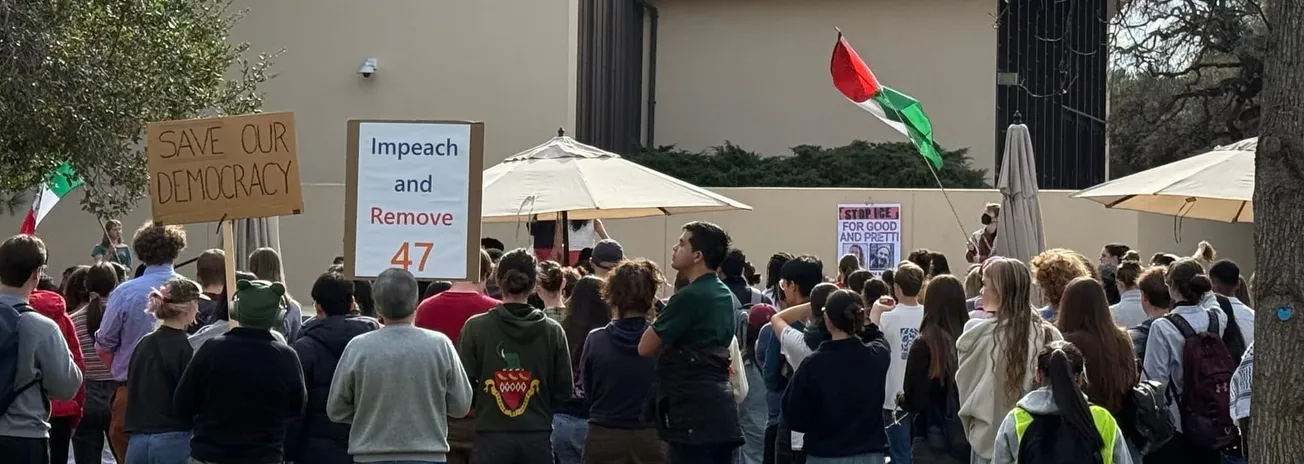
An Orwellian climate of self-censorship prevails, where groupthink is rewarded, and the consequences of showing courage are pervasive. As Stanford Law professor Norman Spaulding recalls, students are “dumped off social lists” and disinvited from dinners for voicing unpopular views in class. This culture of groupthink exploded when protesters shouted down Judge Stuart Kyle Duncan, forcing federal marshals to extract him to safety.
Although censorship is the most blatant symptom, it is not the core problem. It's cowardice: students learn that taking risks gets punished, so they optimize for the safe “ideal” outcome rather than pursuing their convictions.
But this intolerance of dissent is only the surface of the much larger iceberg beneath.
Stanford's freshmen treat campus like a scavenger hunt for resume entries. They apply en masse to multiple highly competitive organizations, such as ASES, BASES, Stanford Consulting, Stanford Finance, SWIB, SWIF, SWIP, and SWE, all of which promise exclusive access to recruiters and resume-enriching professional development events.
The result is a campus culture of high activation energy and low entropy: while it takes massive effort to break out of the existing cliques, the path of least resistance leads directly into a few well-known paths.
One of those well-known paths is Y Combinator.
And that brings me back to the line you hear everywhere on this campus. With over 10,000 applications per batch and a ~1% acceptance rate, YC has become statistically more exclusive, yet less impactful than ever.
Over the last few years, YC has doubled its batches and even added new ones, so that each class now includes hundreds of startups. The composition of these batches is now overwhelmingly AI-based, 88% in the latest round, betraying YC’s once contrarian outlook in favor of safe trend chasing. An article even describes YC as having an “identity crisis,” where YC investors warn that the number of batches dilutes quality, since with so many companies, investors devote less time to each.
What YC offers now is not the thrill of the unknown, but a prestige-hedged risk. The program caps the social downside by tying it to the brand itself; even if the company fails, the “YC Founder” badge remains a transferable asset. It is entrepreneurship sanitized, or, in other words, a risk for cowards.
Why has Stanford’s student body become this way, and how did it get here?
After the financial crisis, hordes of strivers shifted their aspirations from East Coast liberal arts schools to Silicon Valley tech. They chose computer science at Stanford in hopes of a high-paying tech career. As more students applied to Stanford, the exclusivity of our institution skyrocketed.
The 3.7% who are admitted aren’t just smart. They possess a manicured form of intelligence. They embody the one student in your school who is president of MUN and Student Council, has written a thesis on cancer cells, and has sold an app for a million dollars. You can very easily see the optimization logic seep into the culture. Everything you do must be defensible at a dinner with your family and rewarded by the time you sit at that same dinner next year.
The non-conformist impulses get sanded down. The private obsessions are forced into public achievements. The kid who might have been a strange, brilliant generalist in 1994 becomes a cracked resume engineer in 2026.
That’s why the unicorn founder fantasy is so corrosive. Everyone wants the upside without the embarrassment. To accommodate this, Stanford has built an optimization culture that protects students from the risk of looking stupid.
And this optimization culture has a necessary twin: Grade inflation. As a Harvard report, which found the median grade to be an A, explains, the mechanics of grade inflation compress the grading scale at the very top. This renders the 'C' extinct and ensures that mediocrity or failure still yields a respectable result.
But Stanford doesn’t stop at grading. In May 2020, Stanford’s Faculty Senate approved a policy that puts undergraduate majors in a 60–100 unit range. Maybe the policy is right. But it’s also part of a pattern: reducing the number of moments where a student has to stare at a hard thing and risk failing in public.
When an institution reduces major requirements and puts a cap on challenges, you can’t be surprised when the result is a campus full of people terrified of making a mistake. Resilience disappears in an environment that coddles.
As a result, 54% of graduates enter tech, consulting, or finance careers. All while Stanford’s once “golden ticket” CS degree now yields far fewer job offers due to degree inflation.
So when I think back to the conversation with my friend, I realized that despite the joke, my friend was right. People misunderstand what built Silicon Valley. It wasn’t just intelligence. It was the stamina to endure embarrassment, the courage to diverge from the “ideal path,” and the sheer will to keep going.
Stanford is insulating its students from that crucial ability.
Courageous founders don’t need permission; they don’t need YC, ASES, or any other alphabet soup clubs run by the Boba mafia. If you need YC to authorize your risk, you’re not taking a risk.
People forget that legitimacy is what happens after you win. Stanford students, build that island, do something you can’t explain at Thanksgiving, and say what you actually think.
Only then can we restore the courage we have lost.