Table of Contents
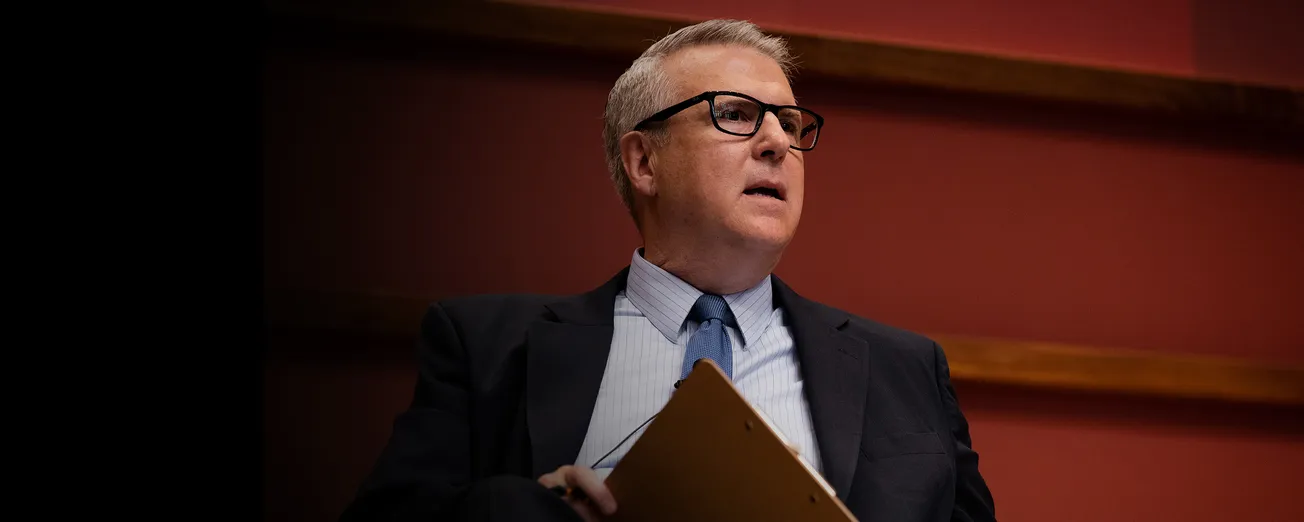
Peter Robinson is the Murdoch Distinguished Policy Fellow at Stanford’s Hoover Institution, the host of Uncommon Knowledge, and a former speechwriter for President Ronald Reagan. Robinson wrote the 1987 Berlin Wall address in which Reagan famously called upon Gorbachev to “tear down this wall.” He is the author of three books: Snapshots from Hell: The Making of an MBA, It’s My Party: A Republican’s Messy Love Affair with the GOP, and How Ronald Reagan Changed My Life. Robinson is also the co-founder of Ricochet. For nearly four decades, he has remained one of American conservatism’s most searching witnesses.
This conversation ranges across the questions that have defined Robinson’s career: the past, present, and future of the conservative intellectual tradition, the surprising patriotism of Silicon Valley’s billionaire class, and the art of drawing truth in interviews. But it keeps returning to Robinson’s true north – his deepening Catholic faith – and what it has taught him about time, craft, and what really matters.
The following interview was lightly edited for length and clarity.
Jack Murawczyk: Let me try to quantify your output. Phi Beta Kappa from Dartmouth. A master’s degree from Oxford. Over 300 speeches written in the White House. Three books. Co-founder of Ricochet. Over 900 episodes of Uncommon Knowledge. What drives you?
Peter Robinson: Fear. At the White House, I was constantly afraid of being discovered for the impostor that I knew I was. The other fear was that if I were found out, I wouldn’t be able to make my rent. I’m not even kidding. I was running scared for most of those six years.
JM: Does that fear continue to drive you today?
PR: Curiously enough, it’s not quite fear of death yet. Still, there is the fear that everything could go belly up at the same time. And the fear of disappointing your family. Although I suppose we could afford a double-wide trailer in some small town in Texas.
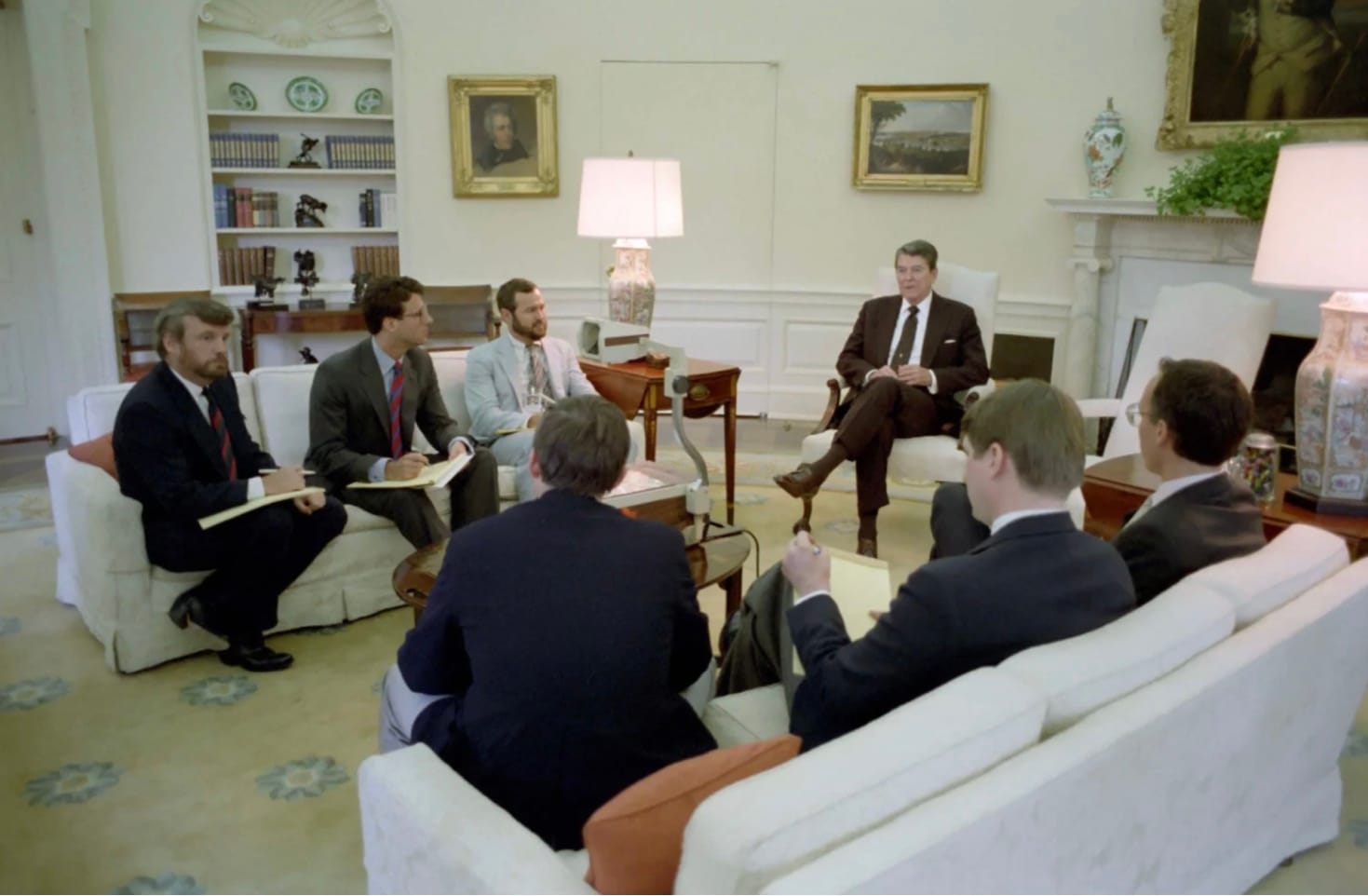
I was just twenty-five when I got hired into the Reagan White House. I was still a kid. One sustaining force through that fear was sheer camaraderie. There were five or six speechwriters on staff at any given time, and three or four of us were very good friends. There was a male camaraderie formed in the pleasure of finding ourselves in each other’s offices, trying out lines, debating ideas, bitching and moaning about the State Department together.
The other force – which may sound like it falls in the range between sentimental and trite, but is a psychological fact of historical importance – was the love of our President.
JM: Which united you with the Kennedy writers.
PR: Yes, that’s exactly right. Did I write that someplace?
Ted Sorensen, who was Kennedy’s speechwriter, and I became good friends, as long as we stayed off politics. By the time I knew him, Ted had stayed with the Democratic Party, which had shifted far to the left from the days of John Kennedy. But what united us was a real admiration for, a pleasure with, a love of our Presidents. John Kennedy was the biggest thing that had ever happened to Ted Sorensen, and Ronald Reagan was certainly one of the biggest for me.
Christopher Buckley was involved in the chain of events at the end of which I was hired onto the White House staff. And the fear returned! I said to Christopher, “What does this lead to?” I’m now a speechwriter for the Vice President, which to me was an absolutely exalted position for a twenty-five-year-old. But I had absolutely no idea where I would go next. And Christopher said, “Well, my father Bill Buckley told me that by the time a man is twenty-six, he should know what he will do when he’s twenty-seven.”
JM: In your latest interview with Peter Thiel, you said that “Russia was supposed to work. China was supposed to democratize. By now, there should have been rudimentary peace in the Middle East.” Yet now, there’s a sense of “free-floating dread.” You spent your twenties working for Reagan, whose favorite joke was about an optimistic kid digging through manure, saying, “There must be a pony in here somewhere.” Let’s apply that heuristic: where’s the pony?
PR: I don’t know. It’s an article of faith that there’s a pony in here somewhere… but can I find it? I really cannot.
The past is a different country. I’m describing a world that simply doesn’t exist anymore, but when I was in the White House, my fellow speechwriters and I felt that the country was really getting someplace.
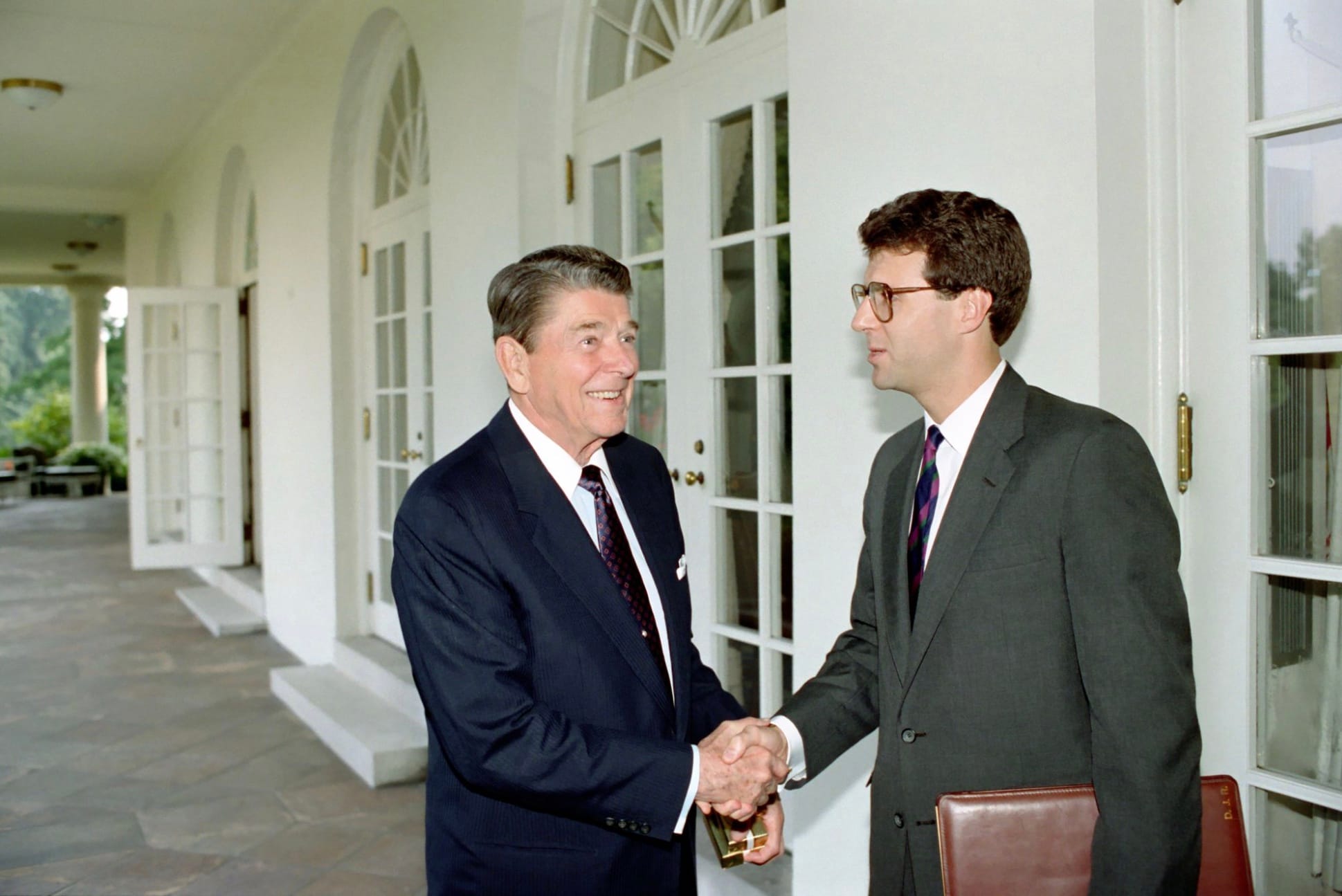
We felt Americans were learning permanent lessons about the importance of low taxes. Milton Friedman had this immense intellectual achievement in the middle of the century, which Ronald Reagan was putting into political practice. We understood Paul Volcker, we had a sound dollar, and we realized how to peel the government out of the economy to release the energies of the people. That looked to me like a permanent achievement.
You look abroad at what Thatcher was doing in Britain, at Pope John Paul II in the Vatican, at the collapse of the Soviet Union… it looked as though we were really getting somewhere.
I was totally naive. Francis Fukuyama, who wrote The End of History and the Last Man, was the one everybody always blames for being naive. But I was just as naive as he was! I thought we had gotten someplace. And I’m still trying to recover from the realization that we didn’t. There were lessons that were simply not learned.
JM: What are those lessons, to be particular?
PR: I’m thinking now of yesterday’s Wall Street Journal. There’s a story about Cuba, now more than six decades after the communist revolution, as the country is inured to poverty. Yet we have Zohran Mamdani in New York talking about going after businesses that leave the city. He’s two short steps away from building a wall around Manhattan to prevent everyone from leaving.
Sixty miles from Florida, we have a living example of the cruelty, the failures, the lies of communism – and there’s a knucklehead in New York attempting to impose socialism in the capital of capital.
JM: You’ve had the opportunity to meet three of your heroes. In your words, “Bill Buckley makes conservatism accessible. Milton Friedman establishes the intellectual foundation. And Ronald Reagan is the one who puts it into practice.” Is there a renaissance? Where is that tradition today?
PR: I’m searching for one. Two weeks from now, I’ll be interviewing Ron DeSantis for Uncommon Knowledge. I hope to interview Marco Rubio, JD Vance, and Ted Cruz.
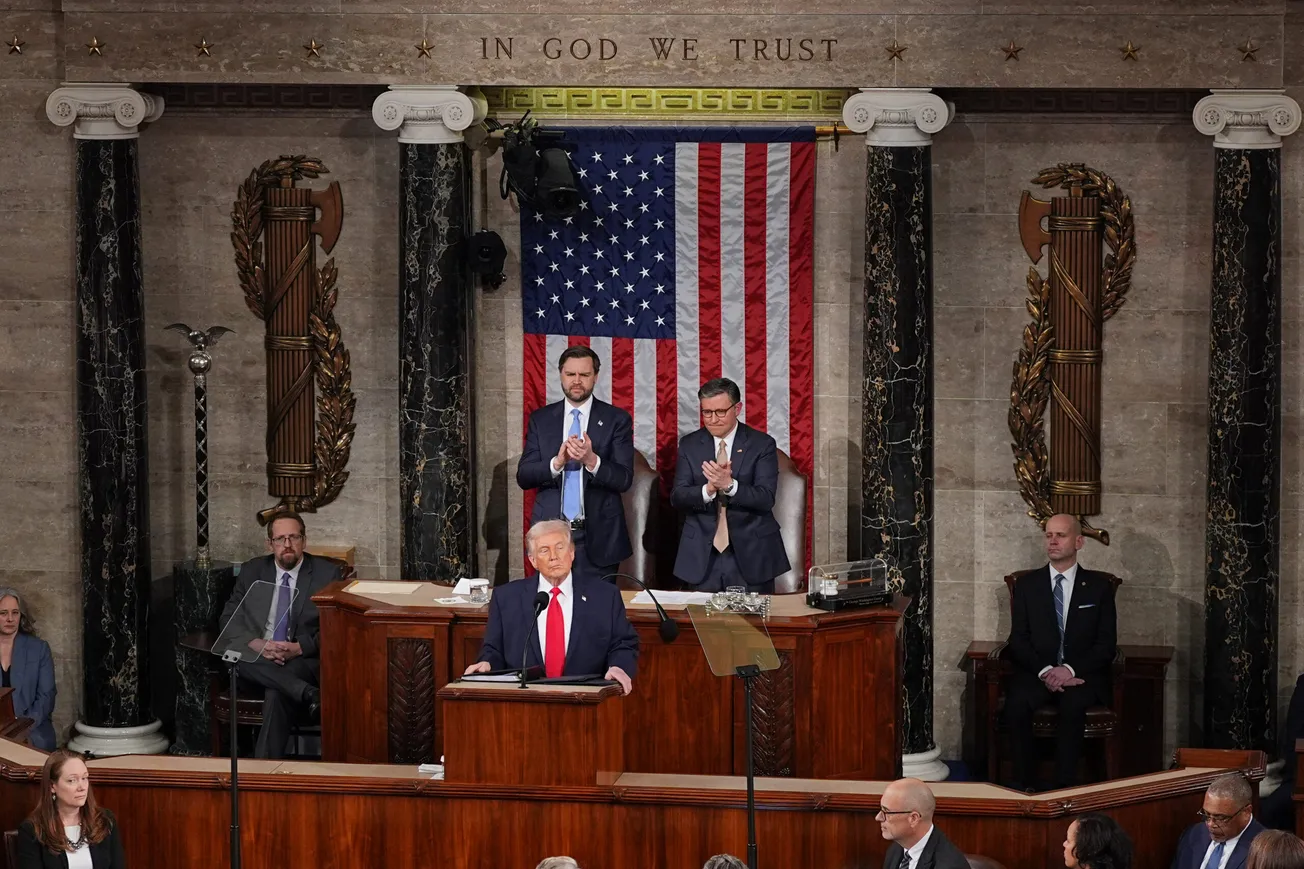
And then there is Donald Trump. He has his virtues, but to me, the really interesting question is that in three years, he’ll be gone. So the question isn’t whether there’s a renaissance in the conservative movement, but what comes next.
If you came up, as I did, under Ronald Reagan and George H.W. Bush, Donald Trump can be very hard to take. At the same time, he’s closed the borders, the economy is growing, he rolled out tax cuts and rolled back regulations, and he’s destroyed or at least set back for some years the Iranian nuclear program. On issue after issue, he’s done what conservatives only talked about doing for years. So how do you consolidate Trump’s achievements, which are considerable, and move beyond?
I don’t know.
JM: You’ve observed Stanford and Silicon Valley from the inside for decades. The tech world’s relationship with conservative politics has shifted dramatically in recent years. What does it mean for the future of the GOP and America?
PR: Samuel Huntington was the point of departure. His essay, “Dead Souls: The Denationalization of the American Elite,” coined the term “Davos Man.” The argument was that, for the first time in its history, the United States had produced a class that had no use for the United States itself, on display each year at the pageantry going on in Davos. Hence the term “Davos Man.”
When the essay came out, I was despondent for a couple of days. It seemed to me so true, and to describe so precisely the kind of person who was emerging here in Silicon Valley. There was a tipping point in the early 2000s when a majority of Facebook’s revenues were from outside the United States. Likewise Apple. Likewise Google. What reason do any of them have to be loyal to the United States?
When Peter Thiel endorsed Trump the first time he ran in 2016, the reaction in Silicon Valley was so violent against Peter that he was receiving death threats. It was really unpleasant. He has told me this himself: he moved down to LA just to get away from Silicon Valley. So as recently as a dozen years ago, Silicon Valley was still made up of Davos Men.
That has changed. Marc Andreessen is almost cracker-barrel patriotic. At Andreessen Horowitz, they’ve set up a fund to invest in founders and companies that support the national interest.
JM: American Dynamism.
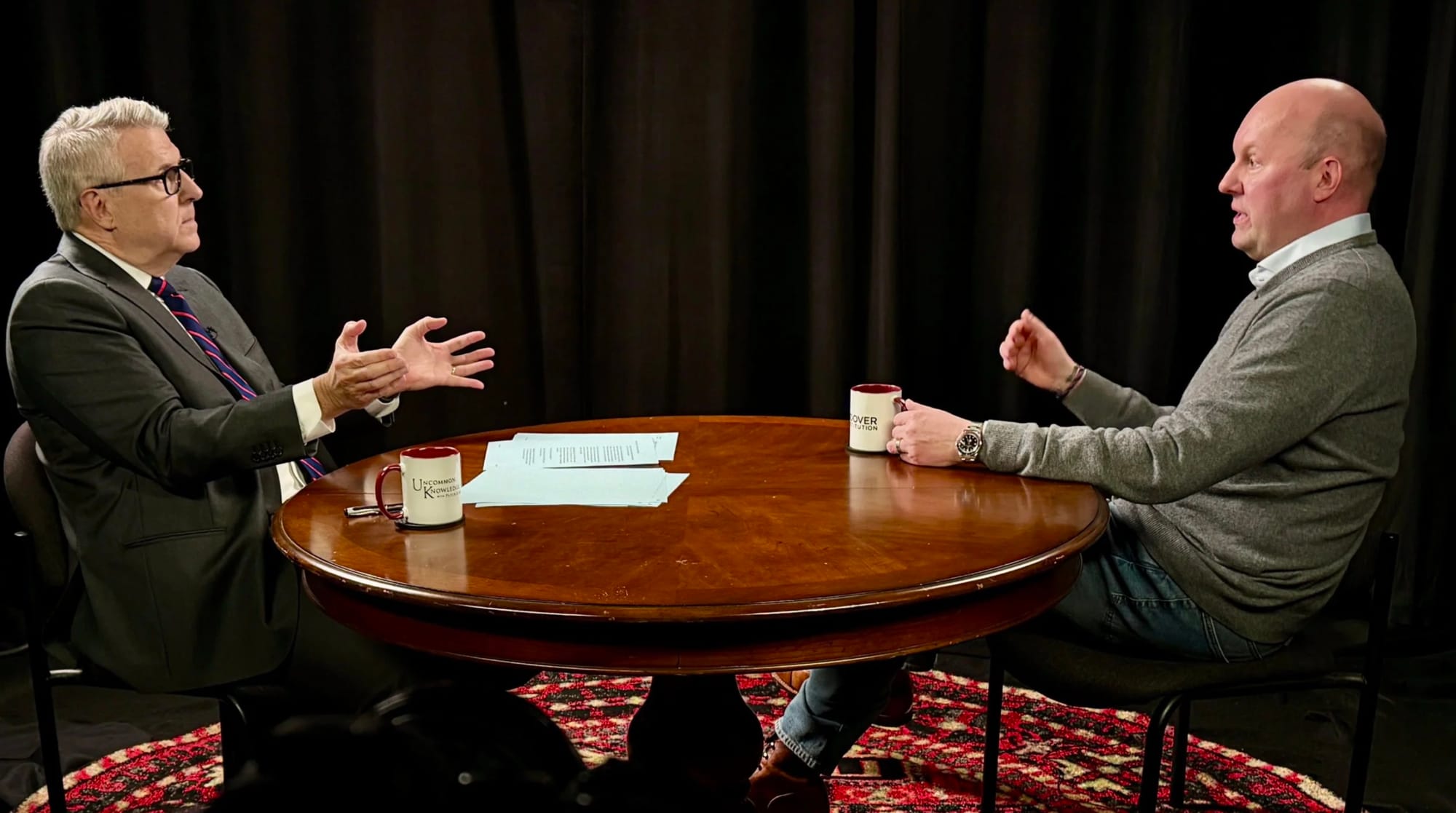
PR: And Elon Musk, I think there probably are countries in Africa that would sell themselves to him for a hundred billion dollars. Take the country, we’ll name it Muskia. Yet he is now thoroughly pro-American. That shift is astonishing. So what does it mean for the future of the country? Nothing bad.
I’d love to do a series of interviews on that very question: why are you patriots?
These men are so rich, they don’t need this country. I suspect part of it is running up against China. All of them now do business there, and are discovering firsthand how bad a bad system can be. China can spend whatever it wants on defense. They will always outnumber us. But we have a capacity for technological innovation that they cannot match.
I understood why someone like Ronald Reagan – who grew up during the Depression, lived through the Second World War, and formed his family in the fifties – loved this country and had a rough plan for it. But if you made Peter Thiel, Elon Musk, or Marc Andreessen president, I’m not sure what the agenda would be.
JM: Do you think this shift is a form of Girardian imitation, or are they all independently patriotic?
PR: Renée Girard was so profound. And yes, to some extent. These guys all know each other. David Sacks, Peter Thiel, Marc Andreessen. There’s a bit of a band of brothers among them. Young guys enjoying themselves on – to use the politically incorrect but nonetheless apt term – a crusade. Mounted up and galloping off against the forces of evil in defense of their country.
Which was roughly how we speechwriters thought of ourselves in the Reagan White House, four decades ago.
JM: Where do you most sharply disagree with the consensus on American politics today?
PR: My most contrarian position is being a big cheerleader for Texas and Florida. What I’ve noticed is that the legislators and governors of both states watch each other closely. If you’re in Texas, you keep an eye on what Florida is up to. DeSantis made an administrative decision at the University of Florida to ban DEI, and Abbott saw that and raised him: they made DEI illegal by statute. And now, DeSantis in Florida wants to abolish property taxes on primary residences. I’m just waiting for the Texas counter.
I suppose in my personal life, while I haven’t become a better person particularly, I’ve become more religiously convinced that almost every bit of Catholicism – even the bits that strike most people, and used to strike me, as mere claptrap, mere spurious accumulations over the centuries – is actually quite true and important. That puts me in a small minority, especially on this campus.
But it’s not a view I trumpet. I don’t trumpet any view. Two months ago, my first grandchild was born. When you reach a certain stage in life, you begin to become less ambitious toward doing big things and slightly shrewder as a pure observer. I’ve become more of an observer.
JM: There seems to be a direct lineage from “Davos Man” in 2004 to the “downwardly mobile” professionals in New York that make up the Mamdani camp today. Is that a continuation of the same trend?
PR: Don’t you think Mamdani views himself as a citizen of the world? It used to be so thoroughly the case that I took it for granted that whatever New York elected, it would elect a New Yorker. As such, Mamdani astonishes me.
I once did an interview with Rudy Giuliani when he was mayor. He had me sit in on his Saturday radio show as people phoned in. A woman from Queens called, saying her garbage hadn’t been picked up. Giuliani said, “What road are you on?” He knew the garbage routes! The man was a New Yorker. You can say whatever you want about him, but the guy was a New Yorker. Dinkins was a particular kind of New Yorker.
Mamdani? It’s almost incidental that he happens to be the mayor of New York. He’s a Davos Man.
JM: Milton Friedman told you economics was a moral matter.
PR: There was a moment in an interview I did with him where I thought I was asking an economic question, and he gave an answer in terms of what the government should do because it was right. I stopped him and said, “Milton, you’re not giving an economic answer, you’re giving a moral answer.” And he said that all important matters are moral matters.
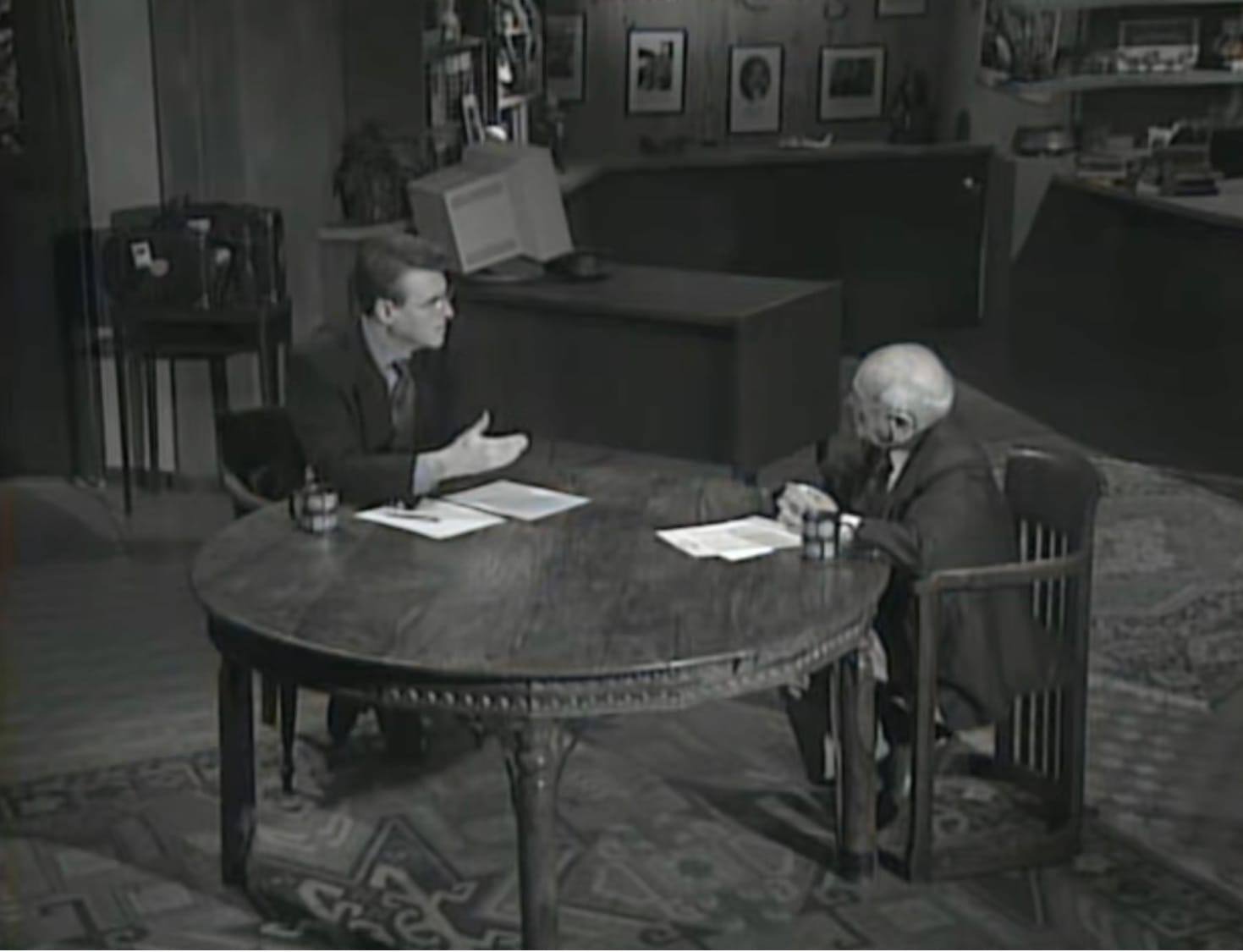
Milton Friedman was a master of the technical side of economics. But for him, it was always a question of how to improve people’s lives. The answer, of course, was that you create the conditions in which they improve their lives for themselves. But it was all deeply moral: what is right, and how do we respect individual dignity?
And the answer was through respecting individual liberty.
JM: So is speechwriting, interviewing, and communicating a moral matter?
PR: Yes! Because if I don’t, I won’t be able to pay my mortgage!
I’m saying thoughts now that I don’t think I’ve said before, and I’m not entirely sure I’m right about them.
In Milton’s generation, Reagan’s generation, my father’s generation, the great question was economic: how do we provide jobs, how do we make sure everybody has food and housing? By the time I came along, the American economy had produced basic abundance. You didn’t have to worry about starving if you lived in this country.
In college, we used to stay up late in the dorms arguing about the Cold War. There were kids at Dartmouth who took Russian because they thought the Soviets were going to win. Now, your generation has gone a quarter century without this country being directly threatened, and prosperity has just bloomed.
Two or three generations ago, the question was: how do we achieve basic prosperity? Then it became: how do we achieve peace for the United States? And for your generation, the question is something else entirely: what does it mean to be human? What is the difference between us and the machines?
JM: You’ve hosted Uncommon Knowledge for almost three decades. What have you learned about the craft of conversation? What makes a great conversation?
PR: When the other guy does the talking. Which I’ve just disproved… I won’t shut up at the moment!
JM: I think in this instance, you are the other guy!
PR: Very true. In every interview, I tend to have a few questions I can’t figure out how to ask, as they have rather long setups, and I’m always self-conscious about that.
I did an interview the other day with Charles Murray, and I was quite pleased afterwards because I got him to elaborate on two or three points without saying a word. I just looked at him quizzically. If all I do is shift around in my seat a little and the other guy keeps talking – perfect!
That’s the aperture.
JM: You’ve said that your favorite guests share a common thread: they tell the truth without fear or favor. Has anyone on your show ever changed your mind…or said something that kept you up at night?
PR: Nobody has changed my mind radically. Christopher Hitchens and I disagreed. Christopher was about three different people. His literary opinions were always correct: he was extremely well read and had perfect judgment in matters of literature, and I felt I learned a great deal from him. The last time I saw him, on New Year’s Day of the year he died, he recited two or three long poems from memory.
On politics, he was about half right. He came around and became a fervent American patriot, but he would never recant his support for Fidel Castro or Ho Chi Minh. So he was right, and he was wrong. And on matters of religion, he was just completely wrong, in my opinion.
But Christopher taught me a great deal about polemics, close reasoning, and friendship. He had an enormous circle of friends that included plenty of people with whom he disagreed. There was a largeness of heart there. I learned from Christopher that a certain polemical determination and sharpness could still be combined with a remarkable largeness of affections.
Has anybody kept me up at night? I did an interview in Washington with Senator Ben Sasse. And Ben has pancreatic cancer.
We go through life putting death as deeply in the background as we can. I did this interview with Ben on Monday, and it was right there on the table. And he was cheerful!
He shifted in his seat a few times because he was in some pain, and he was clearly unwell. But that cheerfulness represented such a combination of bravery and faith. I’ve known him for a long time, but all of this happened very fast. That was the first time I’d seen him since the diagnosis. And I thought this is something almost out of a Russian novel. A kind of courage that I’ve never encountered face-to-face.
That interview comes out on Tuesday. I have no idea how it will strike other people. I’m telling you the way it struck me at the table, and that’s often very different from the way it looks on the screen.
JM: You are a spiritual man. How does your spirituality inform your work and your purpose?
PR: I really do believe that at one point or another, I will be called upon to give an account of my life. And the formulation is that at that moment you will face the most searching, perfect, and complete justice, which is horrifying, but also, at the same time, the greatest mercy. So I’m putting all my money on the mercy. I’m hoping to be graded on a very generous curve.
I was raised a Protestant and taught that all that Catholic business about saints was ridiculous. But I am now totally devoted to saints and believe conclusively in the communion of saints. Whether it’s the religious impulse or sheer longevity, the notion of saints, of people who lived before us and threw themselves on the mercy of God, makes the twelfth century as real as today. It makes the final years of Saint Augustine in North Africa, as Alaric first invades Rome, as real to me as events today. I can feel it, he is heartbroken, he so loved classical culture.
In my experience, thinking about saints, asking them for help from time to time, finding myself drawn to this or that one – it’s a way of putting time in its place. I think time is not a fundamental aspect of reality. It is contingent.
JM: What changed your mind?
PR: Experience. As I was working through the process of wondering whether I should become a Catholic, I just tried praying to a saint or two.
Now, this is unprovable. But what I felt, instantly, was that there was someone else on the line. It wasn’t dramatic. It was like placing a call and having someone pick up. That was quite a big thing for little me.
It’s a cure for loneliness. It’s also a liberation from the heavy tyranny of a particular time and place.
JM: Your wife’s family left Cuba in 1959. My grandfather left in 1961. Those families came here with nothing and built something real. What has that story meant to you, watching it from inside your own family?
PR: We were talking about this as a family the other day. Our children can trace their lineage in this country back to 1630. Those ancestors arrived during the colonial period and settled in northeastern Pennsylvania, became farmers, and stayed there. As other people were building the railroads in New York and creating the financial system, my people stayed on bad farmland in northeastern Pennsylvania and remained poor for almost three centuries.
Recently, we discovered a letter. There was one member of the family who, sometime in the late nineteenth century, left northeastern Pennsylvania and went to California. He was among the first graduating classes at USC. He wrote this letter back to the farmers in Pennsylvania, saying, “Don’t stay there for another winter – come out here, there are apricots, this is a land of milk and honey.” Yet they all said no and decided to stay.
On the other side, my children have Cuban heritage. My father-in-law, knowing that when the time came people would be distraught and important details might be forgotten, took me aside one day and said, “When I die, it’s your job to make sure an American flag is draped over my coffin.”
He is the only person I know who worked in the administrations of both Fidel Castro and Ronald Reagan. He was given no choice about the former, assigned to the revolutionary economics ministry, and it took him about three months to figure out how to get out of Cuba. He eventually served as our ambassador to Guatemala under Ronald Reagan.
So on that side, my children have the direct immigrant experience of rapturous relief at arriving here and a profound gratitude that has never diminished.
JM: You wrote that writing in the White House felt like a kind of “soulcraft.” You’ve been at Hoover for over thirty years now. What does your soulcraft look like today?
PR: It’s still the same thing: writing. I work hard – and I’m impressed that you seem to as well – for each episode of Uncommon Knowledge. Each episode is a form of writing. Having the script, paradoxically, frees me to improvise around it.
I realized when I came to Stanford that I didn’t have the temperament to follow my friends to New York or Sand Hill Road. I would be so much wealthier now. But I couldn’t do it. Somehow, there was a feeling that there was only one thing I was supposed to do. To think things through and put them into words – my own words, and elicit words from others. Humble craft.
I interviewed George Will once, and he said that being a columnist was humble but useful work, like making shoes. And I thought, ahh, yes. That’s it. Humble but useful.
JM: Now perhaps you understand the Pennsylvania farmers.
PR: Yes, maybe so. Good point.
JM: What do you read every morning? What’s on the nightstand?
PR: Every morning, I read the scriptures for the Catholic mass of the day. Then, at some point, I sit at my dining table with a cup of coffee and the Wall Street Journal, which I love so much that I still get it as a physical newspaper. And to see what the enemy has gotten up to overnight, I glance at the New York Times online. I refuse to give them the money for a subscription.
On my nightstand at this very instant: Fyodor Dostoevsky’s The Brothers Karamazov and Michael Connelly’s The Lincoln Lawyer. It turns out The Brothers Karamazov is demanding. I had thought I’d toggle back and forth, but Dostoevsky has made clear that he will reveal nothing else of himself unless I pay him full attention. So I am giving him my full attention.
I am much more naturally at home in Trollope, where people are well-behaved and dignified and imply more than they say. The problem with Dostoevsky is that you feel if you walked into the room yourself and slapped one of the characters across the face – if just one of these people came to their senses for a single moment – the whole novel would stop. But I still love it.
JM: To conclude, what’s the kindest thing someone has done for you?
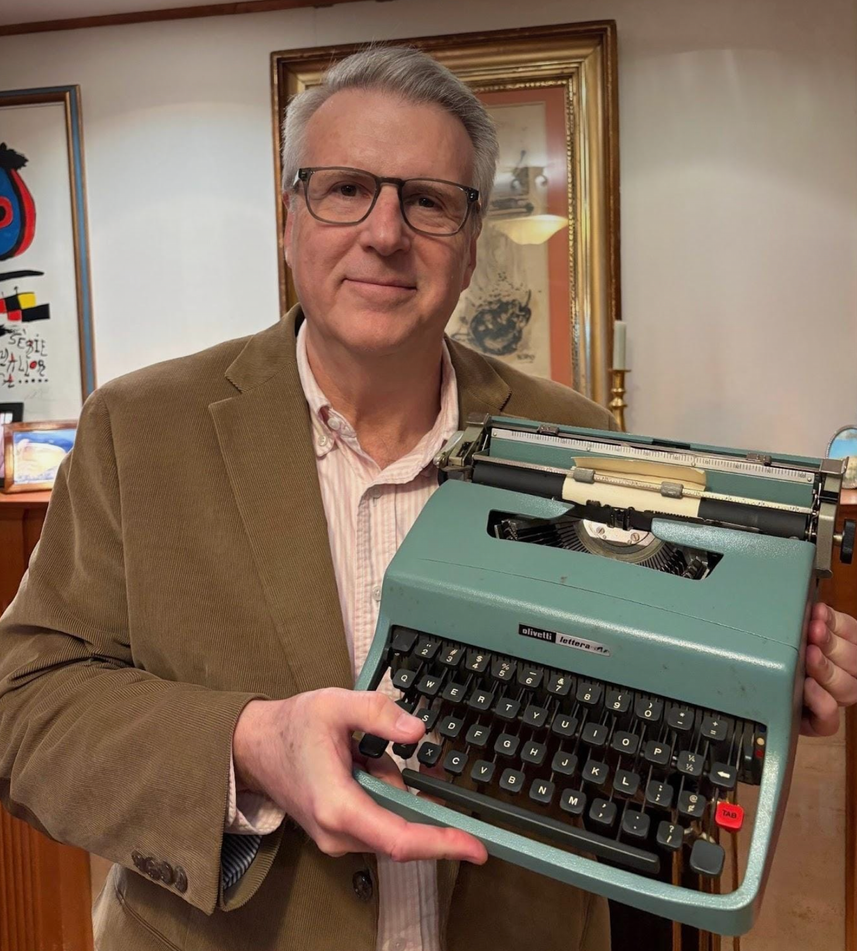
PR: My old friend Christopher Buckley dropped me a line four or five months ago to let me know that the archivist at the Hoover Institution had just visited him at his home in Connecticut, and that he had given to Hoover the typewriter that his father, my hero, friend, and mentor, Bill Buckley, had used in the offices of National Review.
I wrote back and said, “Christopher, very generous of you. I can still recall a photograph of your father using that portable typewriter – the Olivetti – in the back of his limousine. When I saw that photograph in college, I so revered your father that I went out and bought an Olivetti myself.”
Christopher replied: “My father’s Olivetti is now in the mail to you.”
He gave me Bill’s portable typewriter, along with the very photograph I had remembered from almost five decades ago in college. That is just about the nicest thing that anybody has ever done for me.