Table of Contents
Last Tuesday, I grabbed a meal with an esteemed venture capitalist who has spent his career backing student founders. He told me a story of two freshmen at one of Boston’s top universities. They met in high school. Both took rigorous classes landing them at an elite Ivy league university, where they spent months working on an idea to take on space logistics. The investor liked them and so did everyone else. Within weeks, they had dozens of meetings booked, verbal commitments in the millions, and partners at several firms urging them to drop out.
Two weeks later, one of the students called him and confessed. The two friends didn’t meet in high school; they met a few weeks ago at orientation. The idea wasn’t something they had been working on for months; it was a ChatGPT prompt asked to produce a deck that made it look as though they had.
According to the investor, the students had gotten so much enthusiasm that they were overwhelmed. VCs told them they were the next “generational” founders. Then, when it came time to actually drop out and build this supposedly generational company, they couldn’t.
When hearing this, it is tempting to make this a tale about two dishonest kids but I think that misses the entire point. Instead, the question we should ask ourselves is: why would two bright 18 year olds lie about their entire identity to raise money for an idea they had zero conviction in?
AUM Maxing
The answer is a disease I call AUM maxing: the drive to maximize assets under management.
A venture fund is judged on two numbers. The one that matters in the end is DPI (distributions to paid-in capital), the cash a fund has returned to its investors divided by the cash they put in. This typically takes a decade to arrive. In the meantime, TVPI (total value to paid-in capital) is the paper multiple which counts unsold stakes at their latest price and rises every time a portfolio company raises at a higher valuation. TVPI is what a manager shows limited partners when raising the next fund, and the firm’s salary, the management fee, is roughly 2 percent a year of that fund’s size. A $20 billion fund earns twenty times the fees of a $1 billion fund whether or not either ever returns a dollar.
The reality is that it is in every investor’s interest to pump individuals and companies to the highest paper value they can get, point at the TVPI when speaking to their LPs, and raise more money for the next fund. This loop is what perpetuates this cycle of baloney. And you should not blame VC’s for doing so.
Venture funds that raised in 2021 have returned a pitiful five cents on the dollar in cash after five years, the lowest of any vintage this century. A dollar put in an S&P 500 index fund over the same period is worth about $1.82. When the 20 percent carry is a decade away, the 2 percent fee is the only income a firm can count on.
In other words, no partner has ever been fired for paying up in the round everyone else was in. A down round benefits no one. It lowers the founder’s paper net worth, the early investors TVPI, and investors need to raise another fund. So the price only goes up.
The Price Only Goes Up
Start at Stanford: Phia, a shopping app that Phoebe Gates and Sophia Kianni started here, raised an $8 million seed round in 2025 and a $35 million Series A at a $185 million valuation seven months later with no revenue figure. Cluely raised a $15 million Series A from Andreessen Horowitz eight weeks after its seed; its founder later retracted the $7 million revenue figure he had given the press, calling it “the only blatantly dishonest thing I've said publicly online.” Aaru, whose founders were 18, 19 and 15, announced a $1 billion valuation on revenue below $10 million.
None of these founders did anything unusual. Some of these companies are talent acquisition plays, built to attract very smart people through hype and get bought. But the duty of candor to justify an investment keeps getting lower and lower.
The excuse is that AI has made products easy to copy, so there are no moats. The only thing left to underwrite is people with incredible talent i.e. the ex-Palantir FDE or the former Anthropic researcher. Yet how does one value a person? A business has revenue and growth, providing investors with tangible metrics to assess its worth. A person, however, has neither, making valuations increasingly detached from fundamentals. Nobody knows whether a 19 year old Stanford dropout is the next Zuckerberg or Musk, but equally, nobody can prove they aren’t. This uncertainty allows investors to continually reprice the narrative around talent, because the potential of a bright, young founder is theoretically limitless.
In reality, the data does not corroborate. In fact, the median founder of a billion dollar exit is 35, and YC’s own outcomes show founders under 26 fail most often, which is exactly the group the venture market is paying the most for.
Tranches
The clearest example of how these prices get inflated is the tranched round, where a company sells the same class of shares at two or more prices inside a single financing. It usually works like this: The lead investor buys most of its stake at a low price, latecomers buy at a much higher one, and the company announces the higher valuation.
A few examples include Serval, an AI help desk startup, which sold Sequoia a stake at a valuation below $400 million in December and announced a valuation above $1 billion less than a week later; Aaru, an AI synthetic research startup, which had Redpoint invest most of its check at $450 million and the rest at $1 billion, and most predominantly, Ineffable Intelligence, the London AI lab, announcing a $1.1 billion seed round at a $5.1 billion valuation, co-led by Sequoia and Lightspeed in April, with the first tranche priced at about $55 million by Sequoia resulting in an instantaneous 70x markup.
According to Pat Grady, the Co-CEO of Sequoia, in his AI recap to his LPs: “On average sequoia invests in $110m post and after one month, the capital partner price for the company is valued at $3.4B,” This is becoming the new norm. By one investor’s estimate, about a quarter of recent deals are tranched rounds with two prices.
So why would such esteemed venture capitalists and ‘capital partners’ buy in at roughly +30x the price of a tranche sold a month earlier?
The answer comes back to fund size. A firm with billions to deploy cannot put all that money to work through small checks at low valuations. It needs to write checks large enough for a successful investment to make a meaningful difference to the fund’s returns. In that logic, paying up for what it perceives to be the best companies becomes the cost of getting enough money into the round.
But this creates a trap. The early investor marks up the shares it bought cheaply, generating an immediate gain on paper. The company, meanwhile, inherits a valuation it must now justify, and is expected to exceed in its next financing. If the business has not grown into that valuation by the time it needs more capital, it risks a down round. A phrase nobody in the Valley seems willing to say anymore.
Down rounds
Down rounds have become mythology. A down round entails financing in which a company sells equity at a lower price per share than in its previous round resulting in a moment when the private market admits it was wrong.
It has become a thing that 50 year old venture capitalists speak about when gathering around their firepit in Atherton. They remember 1999, 2008, and 2022 but if you were to ask a sophomore or junior at Stanford, Harvard, or MIT what happens if the next round comes in lower, you will usually get a blank look. Why? Because in their short careers, the price has only gone up.
PitchBook has counted between 22 and 36 unicorn down rounds every year since 2016. In the first half of 2026, unicorns raised 444 rounds and only six were down rounds.
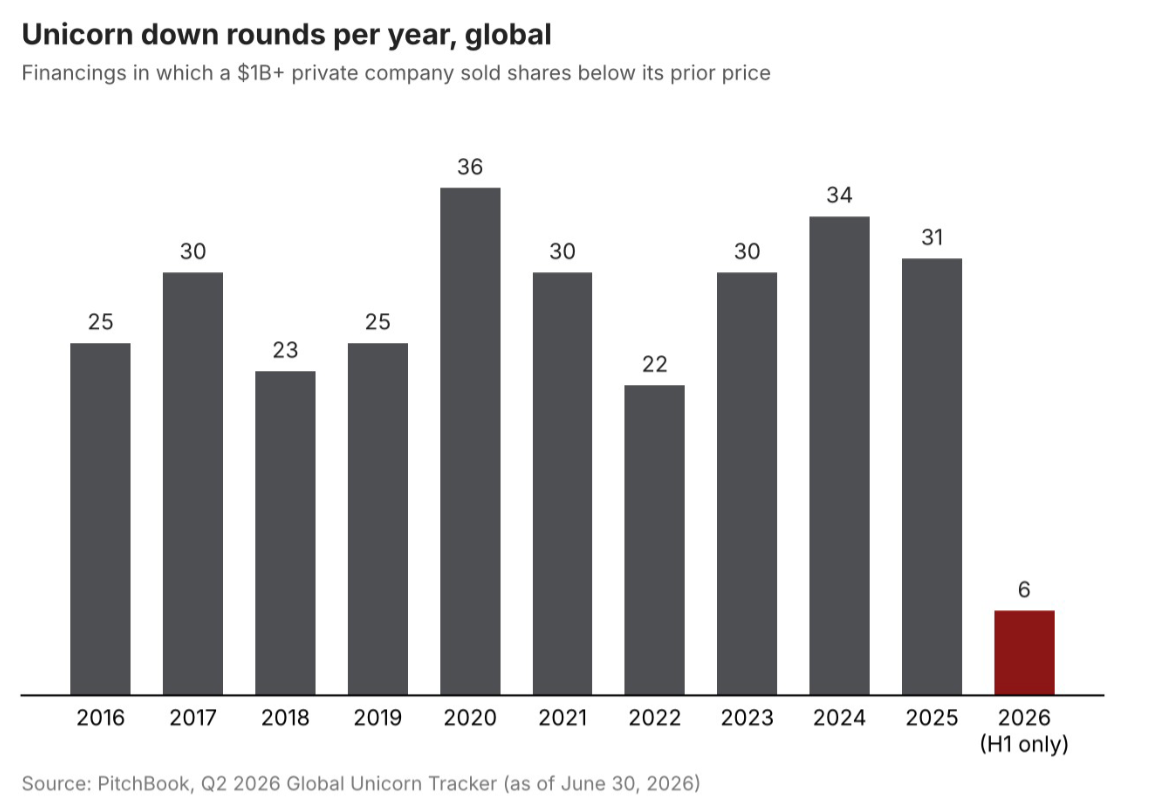
History indicates this does not last. In early 2007, 79 percent of Bay Area venture financings were up rounds and 9 percent were down, the widest gap in the survey’s history. By the end of 2008, 45 percent were down rounds. This is not a new normal. It is what a market looks like right before it inevitably crashes.
When a price can only go up, something strange happens. Investors stop caring about what the company is worth today and start asking when the next round will be.
What will happen
Venture capital cannot indefinitely distribute more wealth than its companies create. Perhaps it will be another financial crisis, a collapse in AI valuations, or simply a decade in which venture funds discover that their extraordinary paper returns cannot be converted into cash. Nobody knows when or how the reckoning will arrive, but the fundamental arithmetic is unavoidable.
I suspect the greatest damage from this cycle will not appear on a balance sheet. Instead, it will happen on campuses like Stanford. The traditional markers of achievement have been replaced by an entirely different scoreboard. In some entrepreneurial circles here, instead of asking what someone has created, people ask how much they have raised. Instead of celebrating revenue, they celebrate valuations.
Which brings me back to the two 18 year olds. When raising money stops being a means to building a business and becomes a means to an end in itself, that becomes a problem.
The two 18 year olds will do whatever it takes to reach that end. We shouldn’t blame them. When the myth of the down round is dispelled, we will not be blaming the lying freshmen but the VCs who funded them.