
Table of Contents
According to the Civil Rights Act of 1964, federally funded universities cannot discriminate on the basis of race, color, or national origin. Since the law was enacted, the White House and universities nationwide have overlooked this fact — until July of this year. Stanford may violate federal law due to the Stanford Weiland Health Initiative, which is conducted through Vaden Health Services in partnership with Stanford Queer Student Resources.
The Weiland Health Initiative is an arm within Vaden and acts as a "collective of medical providers, mental health professionals, staff, students, and community leaders that are committed to serving the mental health needs of queer communities at Stanford."
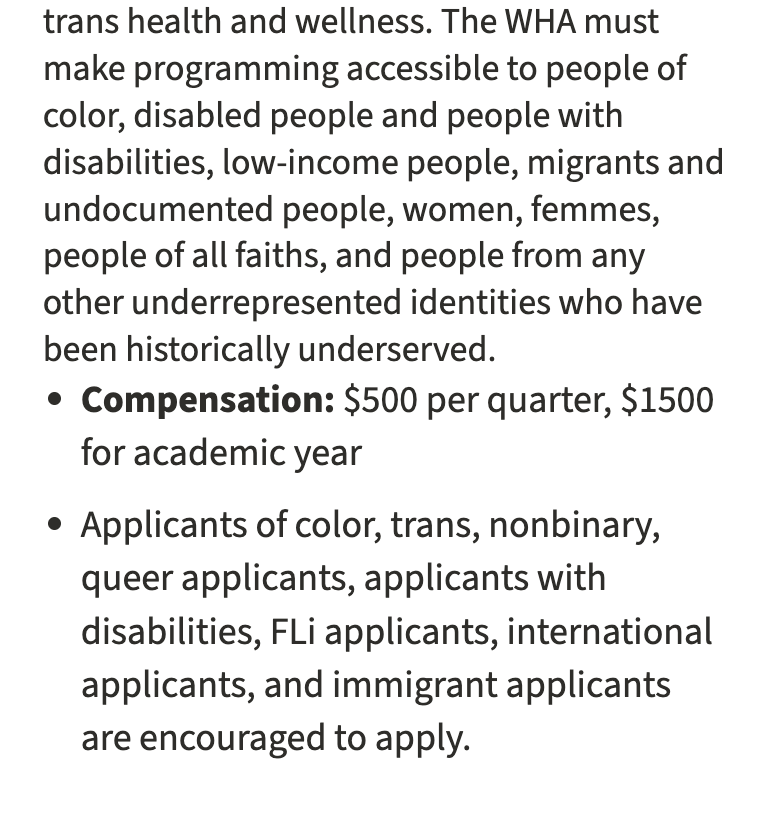
According to the Weiland website, the initiative hires Stanford students as Weiland Health Associates who are enlisted "for supporting the Weiland Health Initiative team as well as larger Stanford LGBTQ+ communities." Their hiring policies may cross the non-discrimination line: "Applicants of color, trans, nonbinary, queer applicants, applicants with disabilities, FLi applicants, international applicants, and immigrant applicants are encouraged to apply." Language that favors specific demographic groups raises questions about whether this constitutes preferential treatment under the DOJ's guidance. According to the DOJ report from this summer, "Using race, sex, or other protected characteristics for employment, program participation, resource allocation, or other similar activities, opportunities, or benefits, is unlawful, except in rare cases where such discrimination satisfies the relevant level of judicial scrutiny."
Despite its role as an organization focused on queer healthcare, Weiland Health Initiative also highlights specific races they target, with a concerted effort to "make programming accessible to people of color, disabled people and people with disabilities, low-income people, migrants and undocumented people, women, femmes, people of all faiths, and people from any other underrepresented identities who have been historically underserved."
This direction of discrimination is consistent with whom Stanford has hired as the interim co-directors of the Weiland Health Initiative. Deb Schneider and Marissa Floro, interim co-directors of the Weiland Health Initiative, cite their professional interests in "unlearning white racial conditioning" and the intersection of "race, identity and gender", respectively. Specifically, Floro co-published a chapter for a book on campus sexual assault where she argued that college campuses intrinsically hold "a myriad of power imbalances" that "include institutionalized homophobia, transphobia, and White supremacist oppression."
Even if the Weiland Health Initiative never practiced any race-based discrimination, however, Stanford would still be funneling tens of thousands of dollars of student tuition into sex-change surgeries, hormone therapy, and a range of classes on unorthodox sexual activity. Here are just some of the programs that Stanford funds through the Weiland Health Initiative:
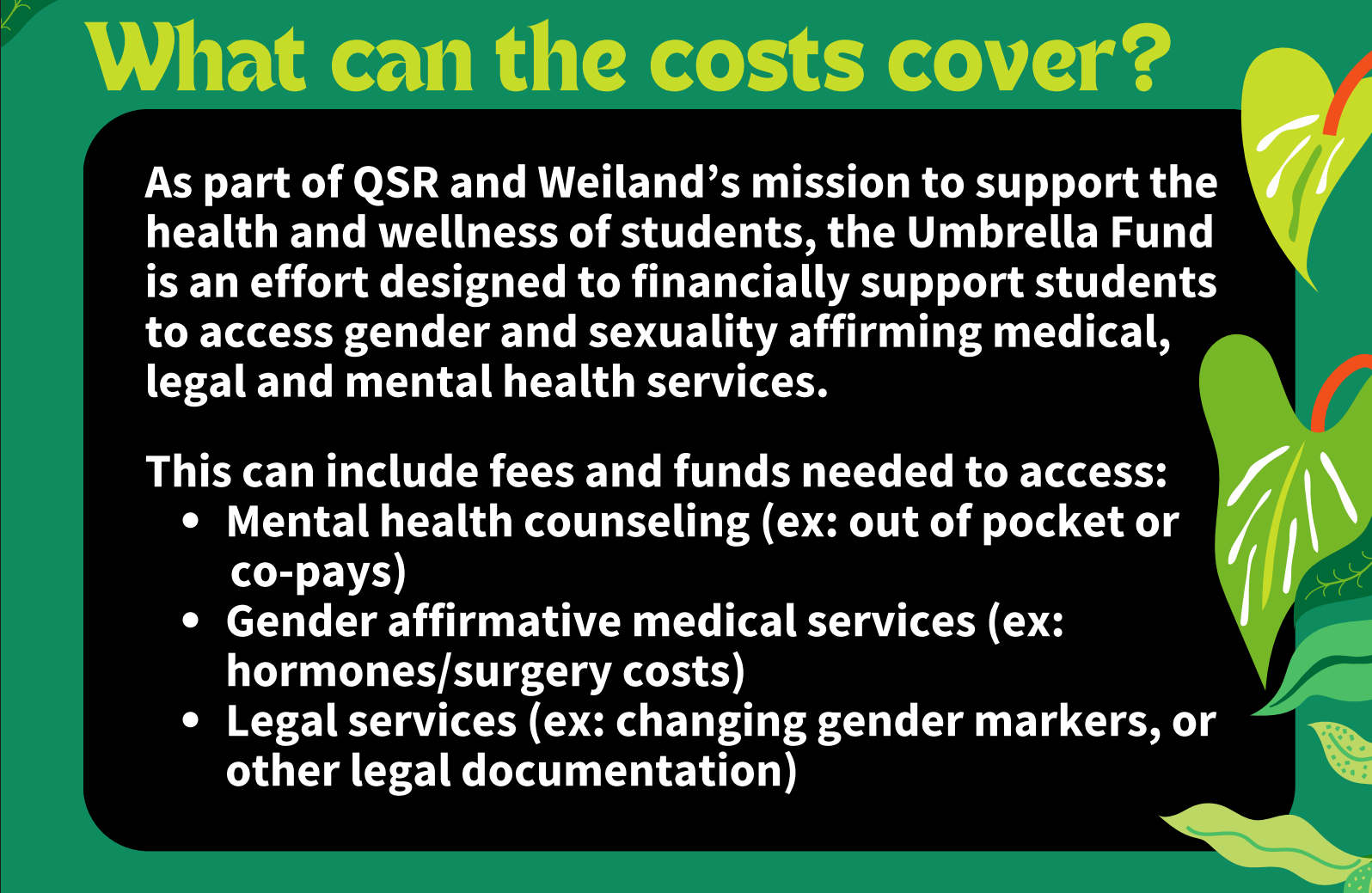
Stanford's Weiland Health Initiative under Vaden Medical Services directly funds this program at Stanford to "financially support students to access gender and sexuality affirming medical, legal and mental health services." They distribute grants of up to $500 to pay for sex-change surgeries, sex-change hormones, mental-health counseling, and legal fees to change one's gender and pronouns officially.

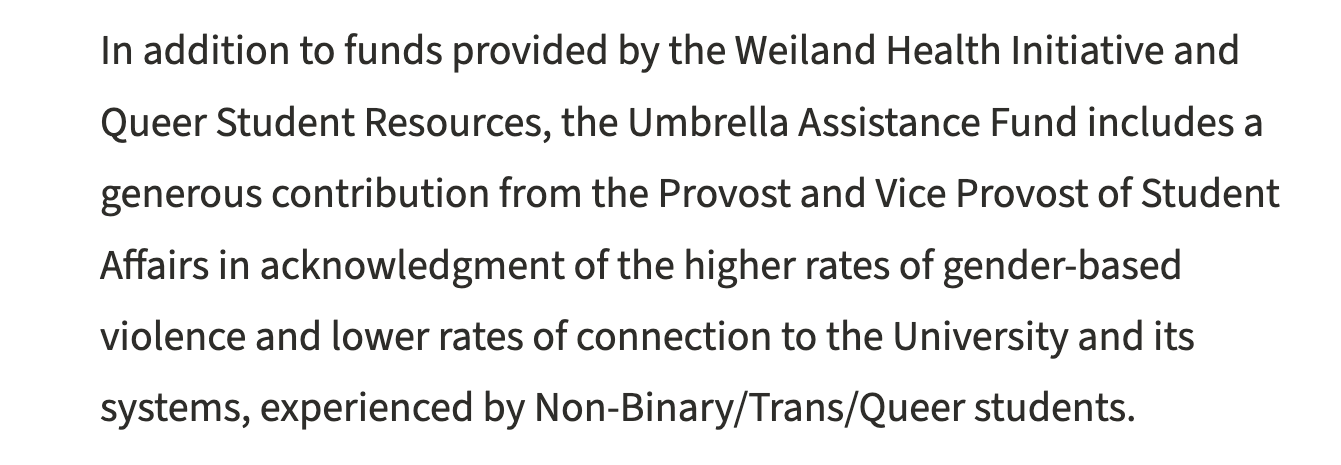
This money is not only coming from private donors: "In addition to funds provided by the Weiland Health Initiative and Queer Student Resources, the Umbrella Assistance Fund includes a generous contribution from the Provost and Vice Provost of Student Affairs in acknowledgment of the higher rates of gender-based violence and lower rates of connection to the University and its systems, experienced by Non-Binary/Trans/Queer students."
This means Stanford is directly funding the program. Furthermore, the language of allocating money to benefit Non-Binary/Trans/Queer students directly may not be in accordance with the DOJ policy of non-discrimination. The DOJ explicitly states in the same report that equity language, as used here to justify provost contributions, is not defensible.
Stanford funds do not contribute exclusively to grants. Weiland offers consultations in "gender-affirming care" surgery, "journeying", and "questioning", a series of programs in "queer yoga", as well as "individual therapy" and "sex therapy" sessions.
Why "journeying" and "questioning" require separate funded classes is not explained.



Classes and Professional Training
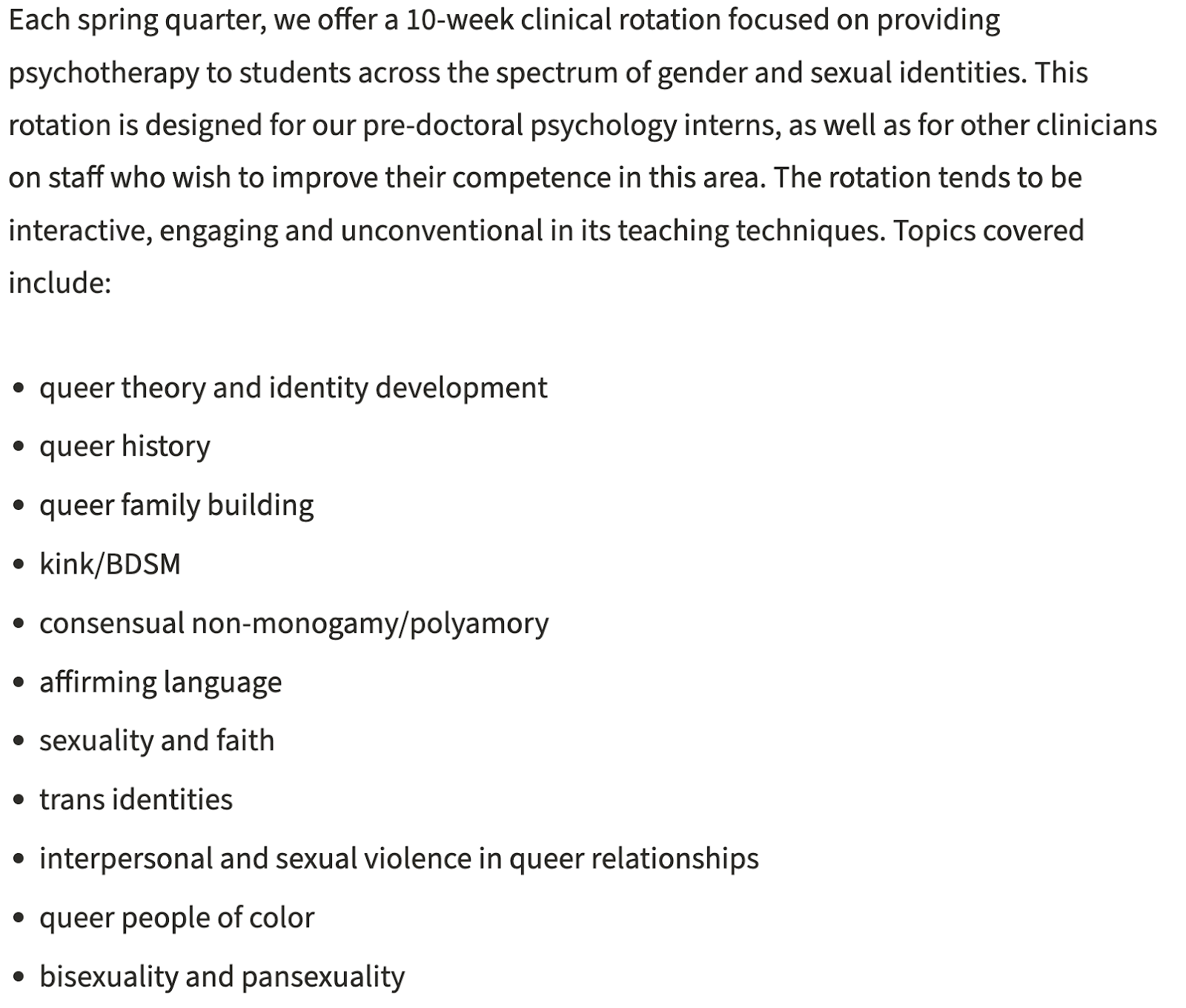
In addition to services and grants, Stanford funds a training program titled "Gender & Sexual Identities Clinical Training Rotation." These sessions are outside of Stanford curricula, and are designed as a way for interns and staff to prepare to deliver "psychotherapy" on the following topics: queer theory and identity development, queer history, queer family building, kink/BDSM, consensual non-monogamy/polyamory, affirming language, trans identities, queer people of color, and bisexuality and pansexuality.
This is just a sampling from the Weiland Health Initiative's extensive programming targeted towards queer students. Amid rapid increases in administrative bloat and the corresponding rise in tuition, the Stanford community should be asking real questions about where the money is going. Accordingly, the White House and the Department of Education specifically should enforce the laws they enact, especially when it comes to Stanford, which can now be considered a consistent and repeat offender. For the Review's part, we will continue to investigate and hold Stanford accountable, whether we find bureaucratic waste, potential illegal activity, kink and polyamory training, or all of the above.