Table of Contents
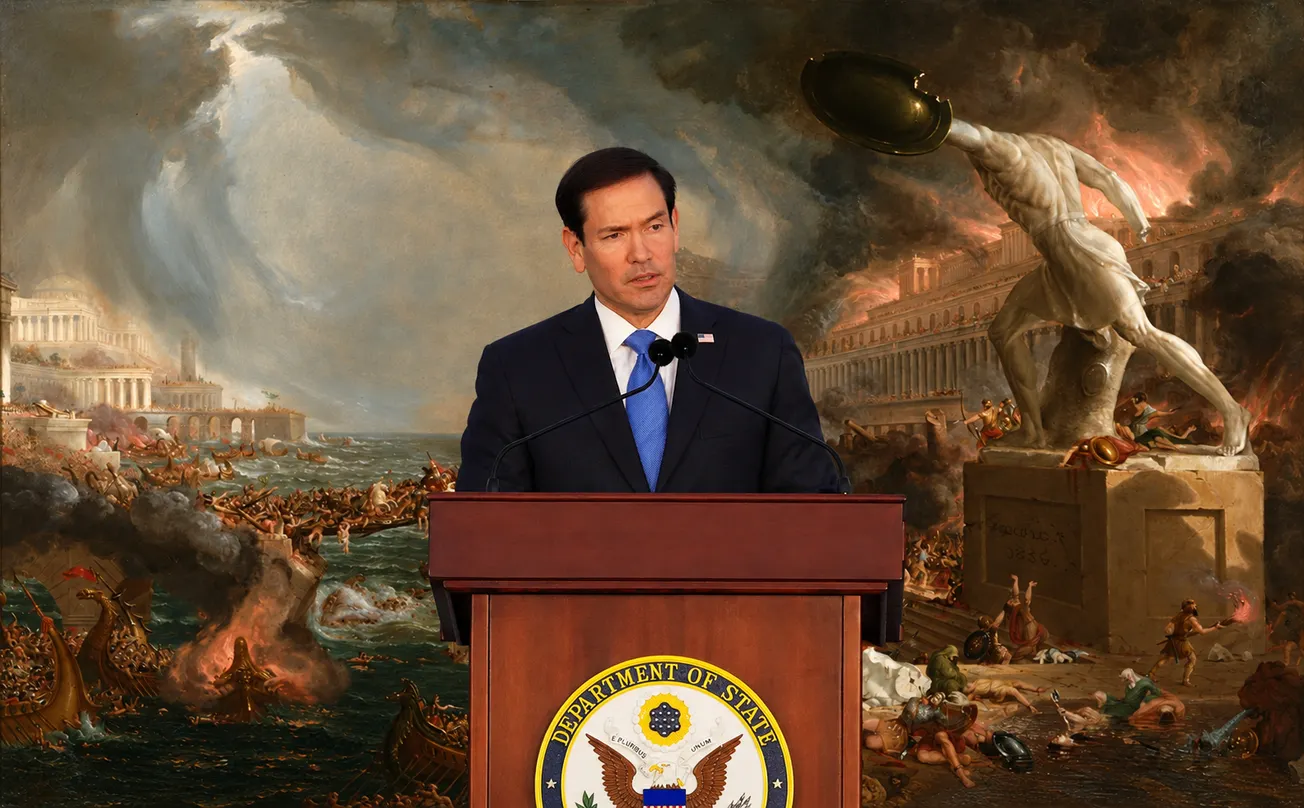
Last Wednesday, Marco Rubio stood in Athens, in my home country, and described the West: ashamed of its own greatness, no longer inventing, neglecting its industry. The cause is cultural; we stopped believing in the ideas that made us great.
In January 1987, about 500 Stanford students marched across campus chanting, “Hey hey, ho ho, Western Culture’s got to go.” Fourteen months later, the faculty senate voted 39 to 4 to end the required Western Culture course. Few people noticed at the time, but it was an early symptom of a much larger shift.
The West is suffering from a fear of one's own home and inheritance, known as oikophobia. Those who suffer from oikophobia align themselves with 'them' rather than with 'us' in any dispute. Oikophobes regard national loyalty as a form of prejudice, and see our customs as something that needs to be apologised for.
The person who first introduced the term, Sir Roger Scruton, described the general trend as a 'culture of repudiation'. The supporters of this view consider Western civilisation together with its traditions, literature and institutions to have been the result of oppression and racism, instead of a heritage that should be preserved. This began in higher education, where universities trained students to believe that no culture is better than another, and therefore that none is worth defending.
But to see what was lost, we have to start where the West itself began: in Athens. Western civilization is built upon the values of fierce individuality and relentless ambition. Daring exploration and invention were catalytic, first in ancient Greece, then ancient Rome, Renaissance Europe, and ultimately the United States.
Western civilization has an insatiable desire for discovery, adventure, risk, and glory. You can trace this back to the Greek pursuit of knowledge and greatness, as embodied by figures like Alexander the Great.
The western spirit is one of institutionalized restlessness. Other civilizations once had explorers, inventors and conquerors, but the West built institutions that convert dissatisfaction and criticism into progress. From Greek contest culture and public philosophical debate to the medieval university, scientific societies, and companies.
As Secretary Rubio said, “It’s the conviction that the unknown can be known.” And let me add that the unknown can be known and will be known. Westerners share much more than a common culture; we share a common anthropology, a common view of man and his place in the universe, and a shared belief that there is an objective, rational order to the cosmos, which is governed by fundamental laws that the human mind can observe and understand. The fuel of our civilization is thymos, the ancient Greek concept of spiritedness, courage, pride, and the desire for recognition. And unfortunately, we have lost it. We have lost the will to fight, to strive, and to survive.
Much of the West stopped taking pride in what made it exceptional. Gradually, people began to feel ashamed of their own heritage, as a new cultural narrative portrayed Western civilization as built on the oppression of less-developed countries and the working class. Monuments to historical figures, including Christopher Columbus, were removed across the United States. This loss of national confidence led Western nations to weaken themselves, offshoring manufacturing to China and leaving their militaries under-equipped.
This shift, though, didn’t happen overnight. Fifteen years ago, in “The End of the Future,” Peter Thiel argued that 1969 marked a turning point: the year of the Moon landing and Woodstock. In his view, the West traded its ambition for technological progress for a culture of countercultural self-expression, and the cultural war over progress was lost. From my view, there are two kinds of culture: the culture of progress and the culture of self-expression. The culture of progress belongs to those who want to build, explore, and invent, while the culture of self-expression emerged from hippies who wanted to challenge convention, redefine identity, and question traditional institutions, without making any meaningful impact on the world.
Over time we came to believe that progress was inevitable. It’s not. The West’s rise was an exception in human history, fueled by generations of individuals who relentlessly worked hard to build something better and push humanity towards the next frontier. Nothing guarantees that this progress will continue. Since the 70s, technological progress appears to have slowed across all fields other than computing.
We are still not travelling faster, energy innovation has failed, nuclear power has been held back by regulation and political opposition, and the war on cancer remains far from won. While the state can still drive scientific progress through nationwide missions like the Manhattan Project and the Apollo program, today’s leaders lack the engineering mindset or the will to build at scale. Few leaders embodied the vision needed to unite a nation behind a scientific mission as well as John F. Kennedy. By committing the United States to putting a man on the Moon, he turned technological ambition into a national mission.
That conviction is what we lack today. The deepest shortage in the West, right now, is not capital, nor compute, nor talent. It’s ideas. We have never been richer, yet we are in a recession of the ones that matter: what a good society is for, what is worth building and what is worth defending. So how do you find new ideas? Look backwards. What the West needs is a new Renaissance. The original is the right model: a rediscovery of Greek and Roman ideas that hardened into ambition, gave us Michelangelo, Copernicus, Galileo, and the voyages of exploration.
The new Renaissance must rest on a few clear ideas. We must make building appealing again, and honor the people who invent, and explore. We need pride in our civilization, earned by what the West has built and never apologized for. We need a society governed by excellence: one that openly recognizes and rewards the best work, instead of treating everything as equally good. One that never sacrifices meritocracy on the altar of inclusion. We need more definite optimists, people ambitious enough to take on the hardest problems and make progress again through relentless work. We need courage: the nerve to take risks, to fail, and to defend our civilization without flinching.
Stanford can start by undoing the mistake that made it a symbol of the problem. Bring back the Western Culture requirement. Make students read Homer, Plato, Thucydides, and the Founders, and learn what the West stands for before they are invited to criticize it.
But above all, we must reclaim our national identity. That means ending the habit of shaming Western history and achievements, and recognizing national pride and loyalty to one’s country as essential to a nation’s survival.
The West still leads the frontier in nearly everything that matters: technology, science, military power, and culture. Whether it keeps that lead depends less on its wealth and weapons than on whether it still believes in the ideas that built it.