Table of Contents
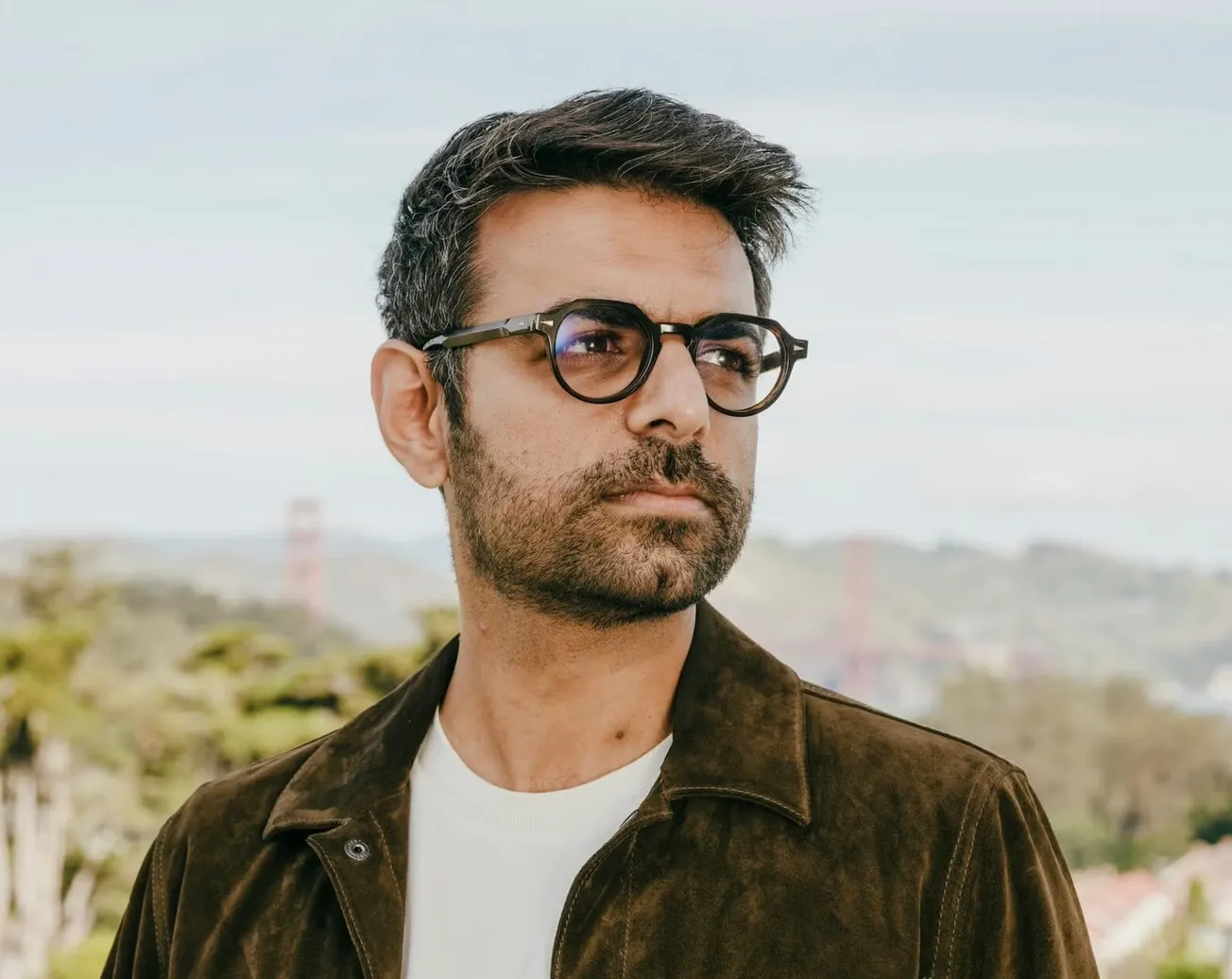
Anjney Midha is the founder of AMP PBC, whose mission is to maximize the world’s frontier output by scaling compute access. A Visiting Scientist in the Applied Physics Department at Stanford, Midha teaches CS 153: Frontier Systems, popularly known online as AI Coachella. Before founding AMP, Midha was a General Partner at Andreessen Horowitz focusing on AI Infrastructure and the Founder and CEO of Ubiquity6.
This conversation follows Midha as he moves fluidly from condensed matter physics to venture capital, The Sovereign Individual to ecosystem stewardship, and the spinodal moments that define markets to the life scaling laws that characterize a life well-lived.
The following interview was lightly edited for length and clarity.
Jack Murawczyk: You have been lauded for your capacity for long-range vision yet you show up to class with a lightness that feels very rooted in the present moment. How do you balance the discipline and sacrifice of building the future while still appreciating the present?
Anjney Midha: I don’t think building for the future requires much discipline and sacrifice. It’s almost addictive. When I think about discipline, it connotes restraint. Yet to me, building for the future is like crack cocaine.
Working on something not yet legible to the world as inevitable is inherently rewarding. The dopamine of puzzling together what the shape of the future looks like has always been the most exciting part of my day. In fact, it has taken a lot of discipline for me to appreciate the present because the future is so intoxicating. The future, at least at this moment in history, feels quite limitless, quite unbounded.
I’ve been spending a lot of time on physics over the last few years. I’m a Visiting Scientist in the Applied Physics Department, and three days a week I spend time with Periodic Labs where we’re trying to discover a room-temperature superconductor.
To borrow an analogy from condensed matter physics – there’s this concept of metastability and phase transition. Metastability is the idea that an entity remains in some state until a phase transition shifts it to another.
In this, there’s a moment called the spinodal: the particular liminal state past which metastability is impossible to maintain. Once the spinodal is reached, the phase transition is inevitable. It’s too late.
I get very excited about moments where there’s a spinodal that isn’t yet legible to the world. There are two ways to approach the future: once you’ve discovered a phase transition, you can, as an investor, hang out and place some bets and wait for things to unfold. Or you can shape the ecosystem!
JM: In Week 1 of CS 153, you put up a slide called “Anj’s Life Scaling Laws.” It’s timeless yet timely advice. How did you derive these laws?
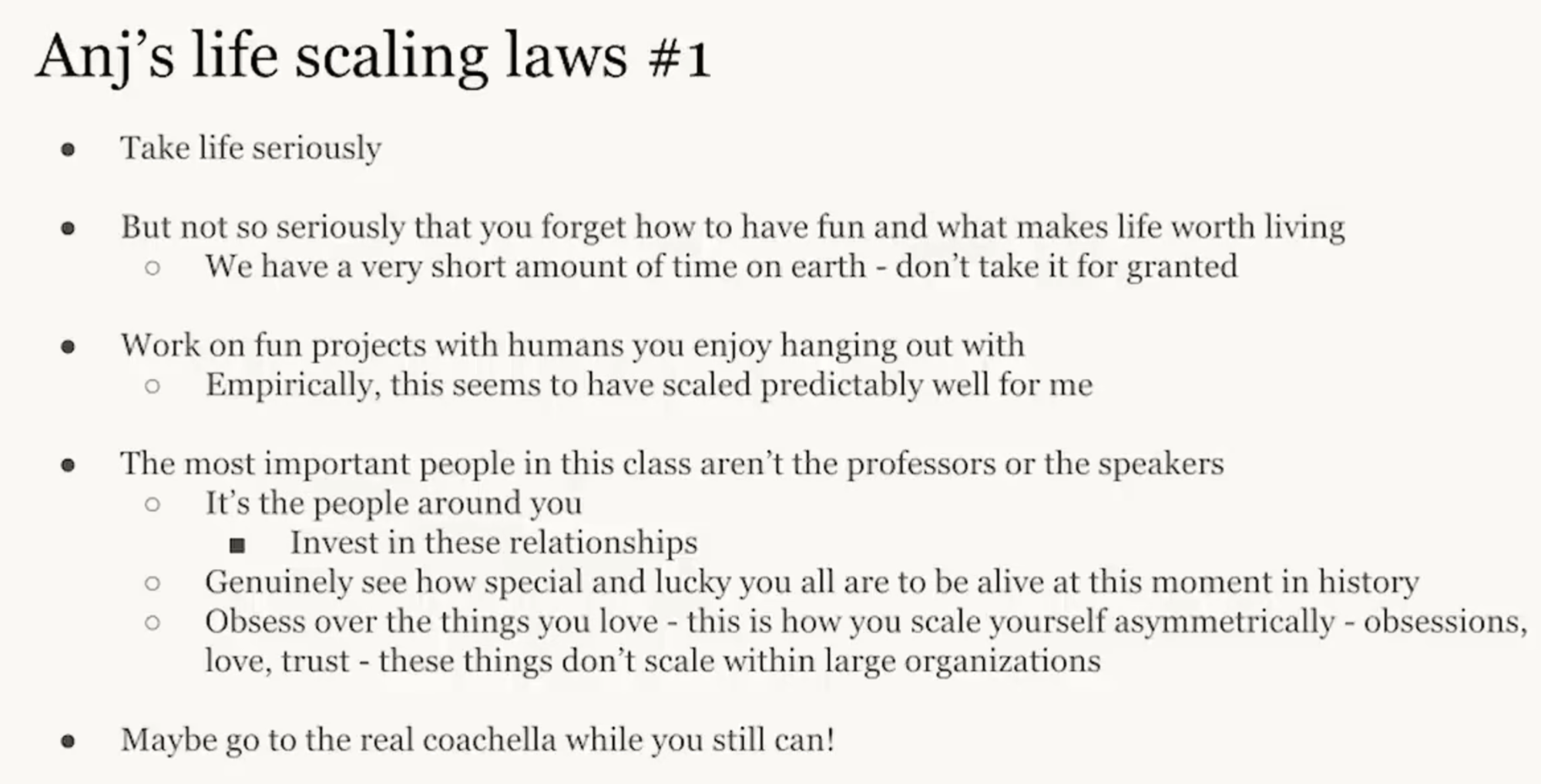
Stanford CS 153 Frontier Systems, Anjney Midha
AM: In some sense they are back to the future. They are modern, but they’re also deeply classical. I went to a boarding school in India called Rishi Valley, founded by the philosopher Jiddu Krishnamurti. The founding theology of the school was this idea of unconditioning: society is constantly conditioning us to think in certain ways, and to be truly free and accomplish your ultimate goals, you often need to uncondition yourself from beliefs that society frames as fundamental assumptions of your life.
JM: What were the conditions that helped with unconditioning?
AM: Every dorm in boarding school had one cassette player. You’d reserve time on a sign-up sheet every day after study hours. I remember moments where I had waited for my turn – I’d signed up days in advance to listen to a new Linkin Park cassette – and then the power would go out. Early on, when I first got to the school, it felt unfair, almost dictatorial. I missed my slot through no fault of my own.
I was there for six years, and by the end I was super zen about it. You’ve seen enough outages and you come to the conclusion that you can’t forecast reality when the infrastructure is just not dependable. So the life scaling laws have come from growing up in an environment where some of the basic assumptions people take for granted were unreliable.
In a very Buddhist way, if you ascribe too much meaning to things that are out of your control, that’s a recipe for a lot of disappointment in life.
JM: Did Stanford recondition you?
AM: When I got to Stanford and was writing for the Review, the most sought-after jobs as a freshman and sophomore were the investment banks, Goldman, McKinsey, Bain, BCG. There was a phase shift happening, and arguably the seed that changed it was the movie The Social Network.
As a freshman, the most popular major on campus was human biology, because it provided maximum optionality – enough grounding in science and math that you could become a doctor, but not so opinionated that you couldn’t become a consultant. There was a sense of hedging that to take life seriously you had to either be at an institution too big to fail or hedge optionality.
I spent a summer at Lazard, a tech bank. I was a sophomore and getting that summer internship in a tech M&A group felt like a meaningful milestone. And I got there and it was a bunch of dudes working on slide decks, and I thought, this is actually deeply unserious.
Meanwhile the most serious stuff was happening in places that looked quite unserious. Sam Altman taught his class when I was a senior, and it was not legible to me why he was spending so much of his time on this nonprofit (OpenAI). It felt like a place for hippies and people who couldn’t cut it in an institution like Google.
But in hindsight, that’s where some of the most important breakthroughs were being worked on. It was, in a sense, a modern Bell Labs.
So the life scaling laws come from my observation that what appears to be serious on the surface is often quite trivial when you boil it down. The most serious pursuits in technology come from what can often seem unserious – working on interesting projects with friends.
JM: The story of the 21 nos on Anthropic is now famous. At the time, you said VCs simply didn’t understand the formula: raise, buy compute, let inference generate both revenue and context feedback. Is there an equivalent formula the tech community is missing today?
AM: Yes, all over the place. Unfortunately, VCs are still not doing their work, and many of them, when presented with similarly legible formulas, are unable to seize the opportunity. That’s fine, because it gives me a lot more room to take ownership where that was more challenging a few years ago.
There are flavors of AI scaling that work, as I say in the class. They need to be 80% the same, with 20% customized for a particular mission or market that a new team is trying to attack. That’s where the art is, and that’s where I get excited about becoming involved as a founding investor – when I get to initialize these teams correctly from the outset.
I get excited when there are really good people who don’t understand that the last mile has to be customized differently from how Anthropic did it. Periodic Labs has a completely different last mile than Anthropic.
Are they both bets on the bitter lesson? Yes. Will they both be extraordinary businesses? Yes.
Are they both exactly the same recipe? No.
VCs don’t get either still. For whatever reason, venture capital has, for the last ten years, systematically attracted some of the least intellectually rigorous thinkers in the Bay. The average talent density on Sand Hill Road has fallen.
JM: Why do you think that is?
AM: Status. It’s so clear to me now that venture capital is the new banking. Young people who want to go into venture capital today see it as a status, high-optionality, hedged, and sure place. I just don’t think you learn that many useful skills there. You go and waste the best years of your life not going deep enough into a particular domain.
If anything, AI makes domain expertise way more valuable. Unless you’re a decision-maker with your own checkbook, where you can write meaningful single-trigger checks, where you don’t have to be consensus, where you can be deeply operationally involved, where you have the freedom to embed with a team and be almost a co-designer of the business early on, you’re just not learning much.
You’re not that different from Claude. Why would you go be the worst version of Claude for much less money when you’re living through the golden Renaissance of technology?
Go attack a domain or problem space you feel really passionate about. Use these tools to create multi-billion-dollar businesses in a few years. Anthropic is a trillion-plus-dollar company in five years. Go do that. Why on earth would you go into venture? It makes no sense to me.
I remember calling Peter [Thiel] up when I was graduating to ask for advice. I said, I have this venture capital job lined up at Kleiner Perkins – do you think I need to be an operator to be a successful investor? He said, no, surprisingly. You don’t need to be an operator. You just need to have deep empathy for the entrepreneur – outlier empathy – to be a great investor.
I just think today, in today’s world, it’s very hard to have outlier empathy for an entrepreneur without doing it yourself at least once. I probably stayed in venture capital too long. The rate at which I learned about what it’s like to be an entrepreneur when I started my own company in 2017 versus what I was doing at Kleiner Perkins – night and day.
JM: Where do you think durable value-capture lives in the AI stack?
AM: From a theoretical perspective, it’s quite simple.
Empirically, you can think of AI systems as distilling the intelligence of a small group of people at these labs – especially the ones crafting the post-training regimes – and exporting their knowledge and intelligence to the rest of the world. Anthropic hired many of the world’s best engineers, distilled their view on software engineering into a pill called Claude, exports that pill to the world, and gets paid for it.
Where will value accrue? If you’re in the 99th percentile and you find a way to export your talent to the world, you get paid a lot – whether it’s through a model, an application, an interface, or an API. In a fundamental Miltonian sense, the trade is: I’m at the peak of my cognitive field and I’m providing that at scale to the world.
The other place value will accrue follows from that. If you have all these people living in Silicon Valley or Freiburg, Germany, exporting their peak cognitive powers and getting paid by the rest of the world, there’s going to be a lot of money for assets they value. Houses on the ocean in Half Moon Bay, private jets. You can think of value accrual following a somewhat barbell distribution: extraordinary hyper-exponential value captured by the top two percent of cognitive workers, and then the top two percent of asset owners with n-of-one premium assets. That distribution seems very clear to me. Everything else is completely hazy.
JM: Talk to me about The Sovereign Individual. How does the 1997 classic inform your view on where the world is going?
AM: One of the key takeaways of The Sovereign Individual is that if you want to predict where the future is going, you should look at the history of violence.
Ultimately, in any society, whichever force, group of people, or institution has the ultimate ability to inflict violence on other people ends up dominating that system. The ultimate violence, of course, is that imposed by a government upon its citizens.
In the macro sense, there’s this tension between technology and politics: policy and politics can override the power of technology with the rule of law. The most disruptive businesses in technology live at the edges of what is legal and what is not. It can feel unfair to people who find unregulated spaces to create innovation that then get regulated.
I read it a few years before I started my company, and it gave me an appreciation for how, when you’re an employer, you have a fair amount of power over your employees, and you can do things that are tantamount to violence. When the pandemic hit, we were at 70 employees and had to lay off about half of them. The Sovereign Individual taught me, among many things, that doing right by those employees mattered, because ultimately I had failed as a CEO to forecast for the pandemic and its impact on our business.
A libertarian might tell you, “well, that’s just the market.” Ironically, reading that book, which is one of the canonical references for libertarians, made me in some ways more socialist. Because I realized that if you’re playing a recursive game in an ecosystem like Silicon Valley, where you want to be a long-term participant, and people lose trust in your judgment and you overuse violence, they just won’t want to work with you.
The long arc of history, if you read The Sovereign Individual, is that the most powerful thing you could do is be an institution unto yourself that people trust – in some sense to scale yourself as a sovereign individual. You want to be somebody whom the people you find to be net positive for humanity can trust to be almost as stable as sovereign infrastructure.
JM: On infrastructure, Samuel Insull revolutionized the 20th century by centralizing fragmented power production into a grid, but the Great Depression exposed the fragility of his leveraged financing and triggered the regulatory era of PUHCA. What does Insull’s story teach you today?
AM: Samuel Insull was extraordinary as a systems thinker – he came up with the whole electrical grid. But measured by his economic outcome, his company collapsed and he died of a heart attack, penniless.
I’m grateful for the lessons of the past. I see myself as a composite of many historical figures. Sam Insull is definitely one of them, but I don’t plan to follow his metaphor to a T.
The big thing he failed to forecast was the impact of losing his neutrality as a grid. He acquired a lot of assets – power generation facilities and factories – that looked like extraordinarily good bets. But to be long-term stable, you have to give up some short-term wins.
I think of it as ecosystem stewardship. A good system is dependable, predictable, and gives up some short-term gains for long-term wins. From an economic perspective, there’s the idea of positive externalities. I’d like to be viewed as somebody who created some meaningful positive externalities, especially for the Silicon Valley ecosystem, the frontier technology ecosystem. One of the mistakes Insull made is he did not think of himself as an ecosystem steward.
JM: Who are the other members of your historical composite, out of personal curiosity?
AM: Arthur Rock is a big leading light – a venture capitalist who helped create Intel and was involved in Apple in the early days. An extraordinarily successful capitalist, Arthur created a lot more value than he captured.
Others I’d like to be a composite of: William Shockley, for his deep conviction in the transistor and the idea of a semiconductor. But he was a really hard guy to get along with, so I try to be more personable than Shockley.
Somewhere between the technical brilliance of a Shockley, with the capitalist effectiveness of Arthur Rock, with the operating scale of Sam Insull. Those are references I find myself endlessly curious about uncovering details around, because I want to make sure I’m not abstracting away their flaws.
JM: Where do you most sharply disagree with the consensus among AI investors right now?
AM: It’s not clear to me what the consensus is in any fundamental sense. What I find is an extraordinary diversity of opinions across the ecosystem. If I sample the consensus inside Anthropic versus inside Andreessen Horowitz versus inside Stanford, there really is no consensus.
This was just a good rhetorical tool Peter used to suss out the quality of thinking of students and candidates. I would probably fail the test by rejecting the notion of consensus. I was offered a job as a forward-deployed engineer when I was graduating, and I probably wouldn’t get offered that again because I’d be viewed as too heterodox or too unstructured a thinker.
If I had to really squint, one consensus would be that AI is an unstoppable engine and there’s no threat to it. Yet I had a conversation with a friend from the White House who expressed a consensus in DC that OpenAI and Anthropic are monopolies and we may want to start thinking about antitrust – which I find absurd. These are startups with a huge amount of competition just behind them.
If there’s antitrust anywhere that should be introduced, it would be in regulating hyperscalers. They are reallocating compute infrastructure for the internal needs of their own teams in a way that is a profound violation of the social contract that allowed them to emerge as hyperscalers in the first place, which was: we have a money printer called search or e-commerce, and we’ll use our marginal cost to provide infrastructure to third-party startups. They’re not doing that anymore. All the supply is sold out for the rest of this year.
If there’s antitrust – and as a Review alum, I’m not supposed to be using that word – I think it’s time for the government to intervene and maybe force a reallocation of compute from the big tech teams to the independent ecosystem.
I remember going for a walk once on a beach in Pacifica with an older investor whom I admired deeply. I told him that compute was going to be a scarce resource over the coming years. He told me, “compute is just sand, it’s just silicon. There’s so much sand in the world. There’s not going to be a compute shortage.” I remember thinking, “Huh, that’s such a simple framework. Maybe I’m wrong.”
I was not wrong.
JM: You spent the summer of 2024 fighting SB 1047, arguing that regulating models rather than applications “would be as if an earlier generation outlawed the printing press, rather than prosecuting miscreants who distributed fliers advocating criminal acts.” What does the right regulatory regime for frontier systems actually look like?
AM: I’m a big believer in optimal scaling. The optimal unit of frontier innovation is a talent-dense, focused team with access to enormous compute. Anthropic in coding, Mistral in open-source models, Black Forest Labs in image models, ElevenLabs in audio models. Each of these teams has produced state-of-the-art outputs with a fraction of the inputs and resources that much larger teams at hyperscalers have produced.
The most efficient way to produce new frontier capabilities for humanity is to give a talent-dense, focused team a ton of compute and free them from the shackles of bureaucracy. Strip all that nonsense out. Just give the team that has the mission they care about and the talent density to accomplish it the compute they need.
If you work backwards from that, that’s the optimal unit.
I’m not using the word small. Anthropic is 2,000-plus people. Small is often relative. Compared to Google, Anthropic is tiny. But the more salient point is they’re focused – focused on the coding frontier – and that’s allowed them to travel much further with much fewer resources than Gemini.
If you take that as a working goal and work backwards, you come to the conclusion that regulation should try to maximize the number of teams that can do compute-optimal scaling.
The market is very slow to correct because of the fog of war.
JM: What is causing the fog of war? Can we just expect capitalism to have its way and that the teams wasting money on expensive training runs will eventually fail?
AM: The primary fog of war is cultural. We are living with attention scarcity in information overload. We have way too little time, way too many responsibilities, all of us constantly getting inundated with noise.
The technology is actually quite simple to understand. AI and machine learning are not that hard. Anybody who watches CS 153, by the end of the ten weeks, should have a pretty good working knowledge of how these systems work.
There are a lot of incentives to keep the truth from being discovered. Lots of market cap, lots of dollars being allocated to places today that should not be allocated. When the truth comes out, there will be massive capital reallocation. To borrow a Marc Andreessen-ism, some people are Baptists and others are bootleggers. Bootleggers are the ones who know the truth but are perpetuating the untruth because it serves their interests. The Baptists don’t know the truth – they believe in their truth and in some sense are religious about it.
The word truth-seeking is actually quite dangerous. What you want is people to be fact-seeking. The facts of the matter are that these are statistical systems trained on data. If we reasoned about them that way, I think we’d all be in a much better place.
JM: You’ve been an advocate for open-weight models and also argued that protecting Western frontier labs against adversarial distillation requires something like an Iron Dome at the inference layer. Those two positions can be seen as pulling in opposite directions. How do you hold them together?
AM: They may seem in tension because people conflate models with products, or models with systems. The class is called Frontier Systems, not Frontier Models. We called it Frontier Systems because more and more commercial value is coming from the orchestration of different models together. Claude Code is a harness with a bunch of models in it. Same idea with Periodic Labs, where LLMs are just one of the models being used.
Distilling the system is very different from having access to the open model weights. The base model weights of a single model are like having one LEGO piece of a sculpture that, when working in unison, is the value. A particular base model weight is a tiny component of an overall system, and it’s the whole system running in production that delivers value. You can reverse-engineer that system through distillation – you can tap the system here and over here and triangulate. That’s what we have to coordinate against.
JM: You were in The Stanford Review as an undergrad. What was it like back then?
AM: It was awesome. In a sense, there was a bit of a know-it-all vibe. We all felt like we were in on a secret, knew a little better than everybody else.
There was a sense of, oh, the Daily is this populist agenda pandering to the masses, and the masses are unquestioning of deep truths. I don’t know if that was true, but that was the vibe. I loved every minute of it.
Lisa Wallace was the editor-in-chief who recruited me, and she was great. John Luttig was my first deputy technology editor. And Brendan Camhi. It felt small, tight, definitely unpopular on campus. Sounds like that’s still the case, which I think is also kind of important for the Review.
There’s some sense of mission alignment required – you need people interested in the tradition of the Review, not for the sake of tradition but for the purity of the inquiry: why are things happening on campus the way they are? Should we challenge the powers that be, these institutions on campus that are in many ways a microcosm of the broader world? Having a healthy sense of skepticism of institutions and the rules of engagement imposed on you as a student turned out to be deeply valuable as intrinsic priors I took into the world.
Peter invited us over for dinner a few times, and that was really cool. The part that left a deep impression on me was the degree to which the Review alums still hung out all those years later. I remember calling Peter up before I graduated. I asked him: “it’s very cool that you all still like each other, or seem to stay in touch. How did you do that?” He said, “Just find ways to work on projects together. And if they make money, that’s even better. Making money with friends is fun.” That left an impact on me. I’ve always viewed the Review community and those alums I was on campus with as more than just friends.
JM: To conclude, what’s the kindest thing anyone has done for you?
AM: Definitely the kindest thing anyone’s done for me is Vivian, who’s my wife, forcing me to stay in Silicon Valley.
After we graduated, I was a one-man traveling band for Kleiner Perkins in Asia, working closely with Mary Meeker. At the time Kleiner had told its growth LPs it would do global investing, but nobody there knew anything about Asia. Having grown up in India and Singapore, I was the obvious candidate. So for six or seven months I spent a week each in Bangalore, Jakarta, Hong Kong, and SF every month.
At some point I said to Viv, “it might be nice if we moved to Singapore so I wouldn’t have to travel back and forth.” She said: “It might be nice for you. Good luck.”
So that was when I quit the job, realized I’d be a Bay Area lifer, and that was the kindest thing anyone could have done for me. Otherwise I would not be here.