Table of Contents
Using AI to achieve “diversity” is far preferable to admitting unqualified candidates.
The hyperfixation on diversity is a hyperfixation on race, which is ultimately superficial. So, why not use a superficial method to “fix” the problem? We no longer have to play the charade of accepting unqualified minority students to achieve the aesthetic goal of equity. We can reach that goal with a 10-word prompt.
A couple of weeks ago, Garret, our Editor-in-Chief, and I interviewed with CNN about the national discussion over our AI race-swap piece. When asked my position on the AI race swap, I told CNN that it was “a beautifully poetic representation of how all DEI policies work in practice. They are always inherently discriminatory, ineffective, and should be stopped in all forms. In this case, the goal was diversity, and they strayed so far from it.”
CNN cut the entire negative framing of DEI I gave, and quoted me as saying, “the goal was diversity, and they strayed so far from it,” as if I supported the goal of diversity on college campuses.
Since we broke the story, students, news outlets, and the Twitterverse have all weighed in on what Stanford’s transgression means. All of them miss the central problem.
As I said in the CNN clip, “the goal was diversity.” That is the problem.
If diversity is the goal, DEI is the means of achieving it. DEI is a top-down approach to diversity that acknowledges disparities between groups and focuses on the outcome of representation, regardless of ability. The effectiveness of DEI policy is judged by whether minority representation has substantially increased.
DEI posits that the best place to fix diversity “problems” is in the final step. It prioritizes an outward appearance over more intrinsically defining features. DEI is fundamentally aesthetic. It applies cosmetic changes to the final product, admittedly in the hope that it fixes whatever structurally lies underneath.
With this in mind, the approaches used are far more intelligible. Admissions and hiring practices take race into account to fix an aesthetic on campus.
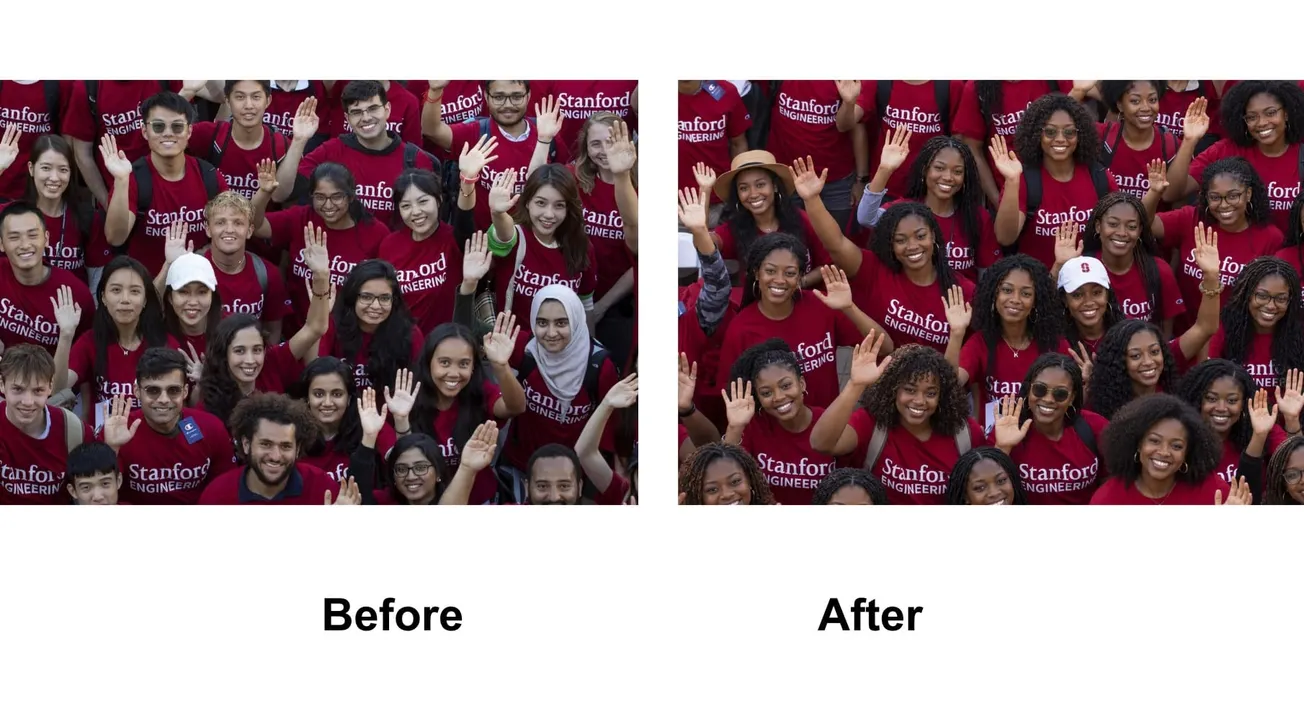
At times, standard DEI cannot fix the aesthetic ideal, and so colleges resort to other means to accomplish it. University of Wisconsin Madison and York College of Pennsylvania photoshopped minority students into campus advertising. And what’s the problem? It realizes the ultimate aesthetic goal of DEI. In this frame, Stanford AI generating a picture of a black woman to score cheap marketing points is not an anomaly or a bug in the system. It is the natural conclusion and final stage of the DEI craze.
Cynical though it may sound, it is better to use AI to fabricate diversity than to admit unqualified applicants to fabricate a diverse campus.
The AI-generated picture is no more “artificial” than the photoshopped pictures from UW Madison, no more artificial than the college photographer seeking a stereotypically diverse friend group for a photo-op, and, most importantly, just as artificial as accepting black and minority students for the purpose of “diversity”. The AI picture just skips these unnecessary steps, and actually avoids commodifying minority students.
“Journalists” like the ones at CNN who interviewed us will try to make this a question of credibility in higher education or AI safety. They have already used the story to argue that Stanford needs more black representation because they needed to AI-generate a black woman.
The first two are uninteresting subplots to the main story. The third is an insidious perversion of the actual truth.
AI diversity ends the degenerative diversity cycle. People are now arguing that Stanford should return to square one and accept students based on race. Of course, such a process flies in the face of the Supreme Court ruling and the current administration’s recent policies.
The ideal is that colleges focus not on aesthetic diversity but on intellectual diversity. Inevitably, Stanford’s bureaucracy will regress to demanding racial diversity. In this case, I hope the AI trend sticks.
Instead of admitting diversity, R&DE should cook it up.
Editors Note: The image used in the photo was generated by the Stanford Review.