Table of Contents
The Review’s investigation into institutionalized racial segregation at Stanford has documented a network of race-based institutions, accounts of prejudice within them, and patterns of student self-segregation. Our findings suggest that Stanford’s diversity efforts have deepened racial divisions rather than bridged them, raising serious questions about the university’s compliance with civil rights law.
On the evening of October 19, I attended a meeting of Stanford BlackGen Capital, an investing club that exists to solely serve Black, Hispanic, and Native American students. Its national parent organization describes itself as “America’s leading minority-owned student investment fund.”
About 25 students were in the room. By my count, all appeared to be Black.
When I entered, conversation stopped and the room turned to look at me. I quietly asked the student seated to my right whether the meeting had started. He said it had. I asked whether the meeting was open or closed, and whether I could join. He said I would have to ask the organizers and pointed to the front of the room.
I asked again, aloud, whether I could join the meeting. A student seated to my left responded: “You need to leave.” Again, I asked whether the meeting was closed. “Yes,” the student said. “You need to leave.” I left. No one explained why I had to leave. No one asked my name, whether I was a member, or why I had come. I was the lightest person in the room, and it was clear that was a problem. Stanford BlackGen Capital is a recognized student organization. Under Stanford’s policy for VSOs, it “must accept any matriculated Stanford student in good standing” and “cannot discriminate on the basis of race, color, or national origin.”
Title VI of the Civil Rights Act of 1964 says that no person shall, “on the ground of race, color, or national origin, be excluded from participation in, be denied the benefits of, or be subjected to discrimination under any program or activity receiving Federal financial assistance.” Stanford receives federal funding.
Stanford also operates four ethnic theme houses, four race and ethnicity-centered community centers, and a network of more than 120 affiliated student organizations, of which BlackGen Capital is just one.
To investigate, we reviewed Stanford housing charts, residential-education requirements, community-center listings, student-government funding records and two decades of student-election coverage. We also interviewed students about their experiences in Stanford’s ethnic theme houses and the wider campus community. Several spoke under the condition of anonymity. Their accounts, cross-referenced against university records where possible, inform our findings. After collating these records, we can confirm that Stanford maintains parallel institutions for Black, Asian American, Latino and Native American students at nearly every stage of undergraduate life. A Stanford student can complete his education without ever leaving institutions defined by his race.
Separate Houses: Stanford’s Ethnic Theme Dorms
Ujamaa centers the Black Diaspora, Casa Zapata’s listed theme is Chicanx and Latinx, Okada has an Asian American focus, and Muwekma-Tah-Ruk centers Native peoples.
Each house describes itself as open to students of every background. Inside, students’ accounts suggest race determines how residents are treated.
At Muwekma-Tah-Ruk, the Native theme house, resident assistants held students to different standards depending on their race. Michael*, a former resident of the house, told the Review that he and several other non-Native students were drinking outside in the house’s parking lot when resident assistants confronted them, threatening to report them to the university. Later, Michael said, he came across the same resident assistants drinking with Native residents of the house inside the house. According to Michael, they asked him not to tell the house’s resident fellow.
At Casa Zapata, the Latino theme house, students described a hierarchy based on ancestry. House discussion followed an informal speaking order: students perceived as having more European, or “colonizer,” heritage were expected to speak last, while Mexican American students from Los Angeles spoke in the middle. Similar conduct extended to meals. In the dining line, a guest speaker once told residents they should be “in the back” or “go first” based on their ethnicity.
An alumnus described persistent conflict between residents over nationality and privilege. Mexican residents born in the U.S. and Mexican residents from Mexico and other Latin American countries frequently clashed over which group was more privileged and which more oppressed. The alumnus described it as the “Oppression Olympics.” These accounts are corroborated by Casa Zapata’s own staff. In February 2023, the house’s resident assistants, ethnic theme associates and resident fellow documented the dining-line remarks and the comments about Central America in an email to the house community, later published on El Centro’s website.
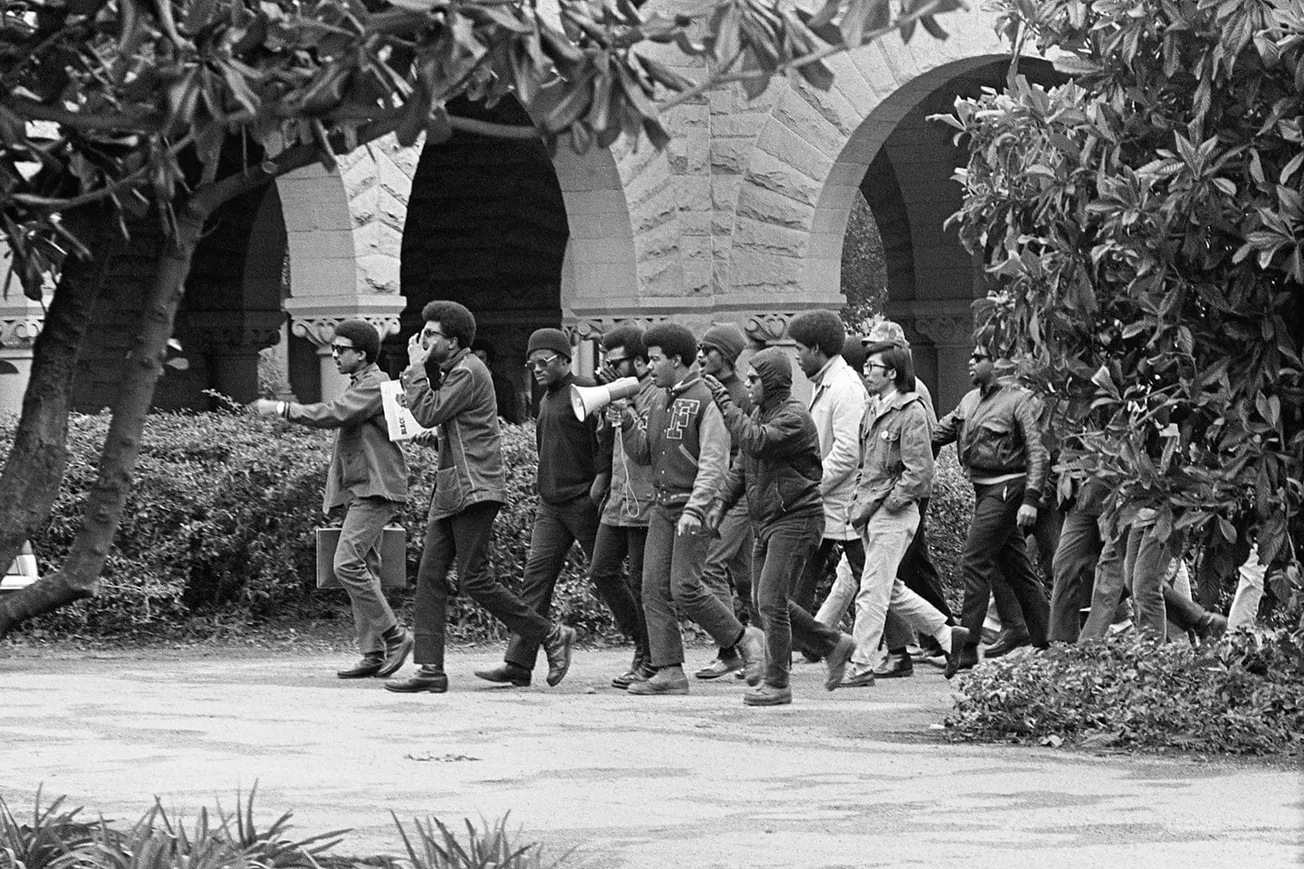
The four houses hold 303 beds, according to Stanford’s 2026-27 undergraduate housing chart. Ujamaa, the oldest, traces its origins to 1968. After the assassination of Martin Luther King Jr., members of the Black Student Union took the microphone from then-Provost Richard Lyman at a campus convocation and issued 10 demands, including the establishment of “a black theme dorm.” Stanford opened it two years later.
More than half a century later, Stanford continues to maintain dedicated residential communities organized around ethnic identity. Stanford’s own archives make the designation explicit. In the Black Community Services Center records held by Stanford’s Special Collections, materials on the house are filed in a folder labeled “Black Theme House (Ujamaa).” These residences are not formally segregated. Stanford states that students of all backgrounds can apply, and Ujamaa’s residential-education page explicitly says students “from all backgrounds are welcome.”
But their ethnic themes are not merely descriptive. They inform the programming and academic obligations imposed on residents. Casa Zapata states that its “ethnic-focused theme creates a common bond.” Ujamaa requires every upperclass resident to take a two-credit, letter-graded course on the Black Diaspora, EDUC 150/AFRICAAM 150. In quarters when they are not enrolled, residents must still attend its presentations at least six times.
For some residents, this arrangement has been a source of community. Marquez Thompson, a current senior who lived in Ujamaa as a freshman, told the Review that he valued the experience.
“I definitely loved my experience in UJ. Really amazing people, students with different experiences but some who shared similar values. I met some of my closest friends there. Such an inclusive space and a really good community.”
Others described the houses differently. Residence is self-selected: when Stanford moved to a lottery in 2025, university spokesperson Luisa Rapport confirmed that only students who had preassigned to a given house would live there. Demand, moreover, exceeds supply. Cheryl Brown, Stanford’s assistant vice provost for residential education, acknowledged that “we simply had more applicants than available spots.” Stanford has not published figures on how many residents come from outside each house’s focal community.
Winston Lee, a classics major in the Class of 2027, described the pattern he has observed: “What strikes me more is the social separation. Whether it’s in dining halls, classrooms or campus activities, I have observed students congregating along racial and ethnic lines. MLK’s dream was unity, not separation. Ujamaa appears to reinforce the latter. It feels like racial self-segregation.”
“Many minority communities, especially many Asian communities like Okada, want to create their own insular in-groups that aim to essentially create their own ‘mini Asia’ and often actively try to bring in other members of their specific demographic,” said a junior in the Class of 2028, who spoke on the condition of anonymity. “They disassociate with broader American culture in their use of non-English language, food/entertainment.”
In February 2025, the U.S. Department of Education ordered federally funded universities, Stanford among them, to cease race-conscious practices, including in housing. That May, Stanford replaced student-reviewed applications to the ethnic theme houses with a random lottery. Rapport stated that the change “was made to eliminate any potential perception of bias that could have existed in the current process.”
For the 2026-27 academic year, Stanford adopted a common application, and house leaders now review applicants’ written answers with demographic information removed. The houses’ themes remain organized around race and ethnicity. In effect, the Black community center remains a Black-only space; it is described as “The Black House” in its marketing materials. At Ujamaa, the racial composition has been set by rule. In 2014, The Stanford Daily reported that half of Ujamaa’s residents were required to be Black. Stanford has not publicly stated whether that requirement remains in effect.
The arrangement has long drawn criticism. The same report noted complaints that students felt uncomfortable in the house. Ujamaa’s resident fellow at the time, Jan Barker-Alexander, acknowledged that students who were not Black might feel uncomfortable there, but defended that discomfort as a source of growth.
In fact, the discomfort is built into the house itself. Since its inception, Ujamaa has practiced racial segregation. One alumnus, who was randomly assigned to the house, said residents held separate house meetings: one for Black residents and one for residents who are not Black. Ujamaa formally admits students of every race, but once inside, residents who are not Black are set apart from the house’s community. In practice, the house enforces the very separation its admissions policy disclaims. Black residents make up the house’s core, while everyone else is sent to a meeting of their own, treated as second-tier residents in their own home.
The Centers
Beyond housing, Stanford operates four community centers organized around race or ethnicity. The oldest, the Black Community Services Center (BCSC), opened in 1969 in response to the same Black Student Union demands that produced Ujamaa, making it Stanford’s first community center. The BCSC refers to itself as “The Black House.” The other three centers followed: the Asian American Activities Center (A3C), El Centro Chicano y Latino and the Native American Cultural Center (NACC). All four now fall under the university’s Centers for Equity, Community, and Leadership.
Each center anchors its own network of student organizations. Together, the four list more than 120 affiliated groups: more than 60 at the Asian American Activities Center, more than 30 at the Black Community Services Center, 25 at El Centro Chicano y Latino and more than a dozen at the Native American Cultural Center.
The racial organization of student life extends to mental-health care. Since 2011, Stanford’s Counseling and Psychological Services (CAPS) has placed clinicians inside the identity centers, through a program now called “Let’s Talk in Community.” The Black Community Services Center advertises “Black CAPS,” with three Black clinicians, and the Asian American Activities Center lists clinicians who “self-identify as Asian American.” Students are told to book with “the community center or program you feel most connected with.”
No such option exists for white students. Stanford operates no center for them, and so no counseling program is offered through one. A Black, Asian American, or Latino student in distress can seek a counselor through a center organized around his race. A white student cannot. CAPS states that its consultations are “free for Stanford students,” and none of the centers’ pages bars students of other races from booking. But the university has chosen to organize even the delivery of mental-health care around racial identity, sorting both clinicians and the students they serve by race.
Clubs to Careers
The pattern extends well beyond social life. The NACC lists Natives in Medicine and Natives in Pre-Law among its affiliates, while El Centro lists the Society of Latinx Engineers. Students can also join Black in Computer Science, and at the Graduate School of Business, Black, Asian and Latino business associations. The Asian American Activities Center also lists ASES among its affiliates. ASES was founded at Stanford in 2000 as the Asia-Pacific Student Entrepreneurship Society and now describes itself as Stanford’s Global Entrepreneurship Society.
The track extends into finance as well. In 2026, students founded Stanford BlackGen Capital, a chapter of a national organization that describes itself as “America’s leading minority-owned student investment fund.” Despite its name, the organization serves Black, Hispanic, and Native American students. The Stanford chapter states that it exists to close the “access gap to finance and consulting” for underrepresented students.
The Coalition
The same divisions have shaped student government. Although the Undergraduate Senate is elected by the full student body, for nearly three decades the most influential endorsing group in its elections was the Students of Color Coalition (SOCC). The bloc was built around the Black Student Union, the Asian American Students’ Association, MEChA (Movimiento Estudiantil Chicano de Aztlán) and the Stanford American Indian Organization.
The coalition’s influence was considerable; in 2011, 12 of the 15 Senate candidates the coalition endorsed won seats. One student told The Stanford Daily at the time that it could feel as if a few coalition leaders were “choosing the Senate for the next year.” SOCC dissolved before the pandemic. This April, Undergraduate Senate Chair David Sengthay announced in a Stanford Daily op-ed that he was rebuilding it. Sengthay coordinated a joint Senate endorsement anchored by the Asian American Students’ Association, the Black Student Union, Stanford Natives and Stanford Powwow, along with a first-generation student group and the physics society.
Grants and Donors
Most of the money behind Stanford’s affinity infrastructure comes from student fees. In 2026-27, every undergraduate is charged a Student Activities Fee of $247 per quarter, or $741 a year, built into the cost of attendance. Students can waive it, but only by confirming they will not participate in any organization the student government supports. Those fees are distributed through two channels. Each spring, students vote to approve Annual Grants to individual organizations. Throughout the year, the ASSU’s legislative bodies, including the Undergraduate Senate, distribute additional funding weekly. The Senate says it allocates more than $6 million annually to more than 600 voluntary student organizations. Funding records illustrate where that money goes.
As the Review reported in May, student-government funding records compiled by the anonymous group ASSUTracker show race and ethnic affinity groups receiving $720,433, more than the $677,635 directed to all of Stanford’s engineering clubs combined. Black and African groups alone receive $354,246. Separately, in September 2025, the Senate approved $4,533.63 for a mural tied to the Black Community Services Center’s Black House Reimagination Initiative. Sengthay said the Senate had a responsibility to support marginalized students by funding “cultural spaces that foster belonging.”
Separate Commencements
The track concludes at graduation. Each spring, alongside Commencement, students may attend the Black Graduation Celebration, the Asian American Graduation Celebration, Nuestra Graduación and a Native American graduation ceremony. Each is organized around a single racial community. The Black Community Services Center hosts the first, a tradition that marked 45 years in 2020. As with the ethnic theme houses, these ceremonies say they are open to all. In practice, their participants belong only to the community each ceremony celebrates.
A Clearer Picture
After collating our findings, a clearer picture emerges. A non-White Stanford undergraduate can live, gather, vote, organize, prepare for a career, invest and graduate within institutions organized around his race or ethnicity for all four years. Each is housed or recognized by the university or its student government. Three years after the Supreme Court ended race-conscious admissions, Stanford has not closed any of the institutions documented in this investigation. In fact, several have expanded: a Stanford chapter of BlackGen Capital was founded, the Undergraduate Senate funded a new mural at the BCSC, and the Senate’s own chair moved to revive the Students of Color Coalition.
The Black Community Services Center has its own name for what those institutions add up to. Its welcome page for incoming students does not describe Black students at Stanford. It describes “Black Stanford.” The phrase is the center’s own, and it captures what this investigation documents: within a university meant for students of every race, faith and culture, Stanford has built four additional smaller Stanfords, each defined by race.
Author’s Note: This investigation draws on interviews with both current and former Stanford students conducted between September and November 2026, along with university housing records, community-center listings, student-government funding records and archival materials.