Table of Contents
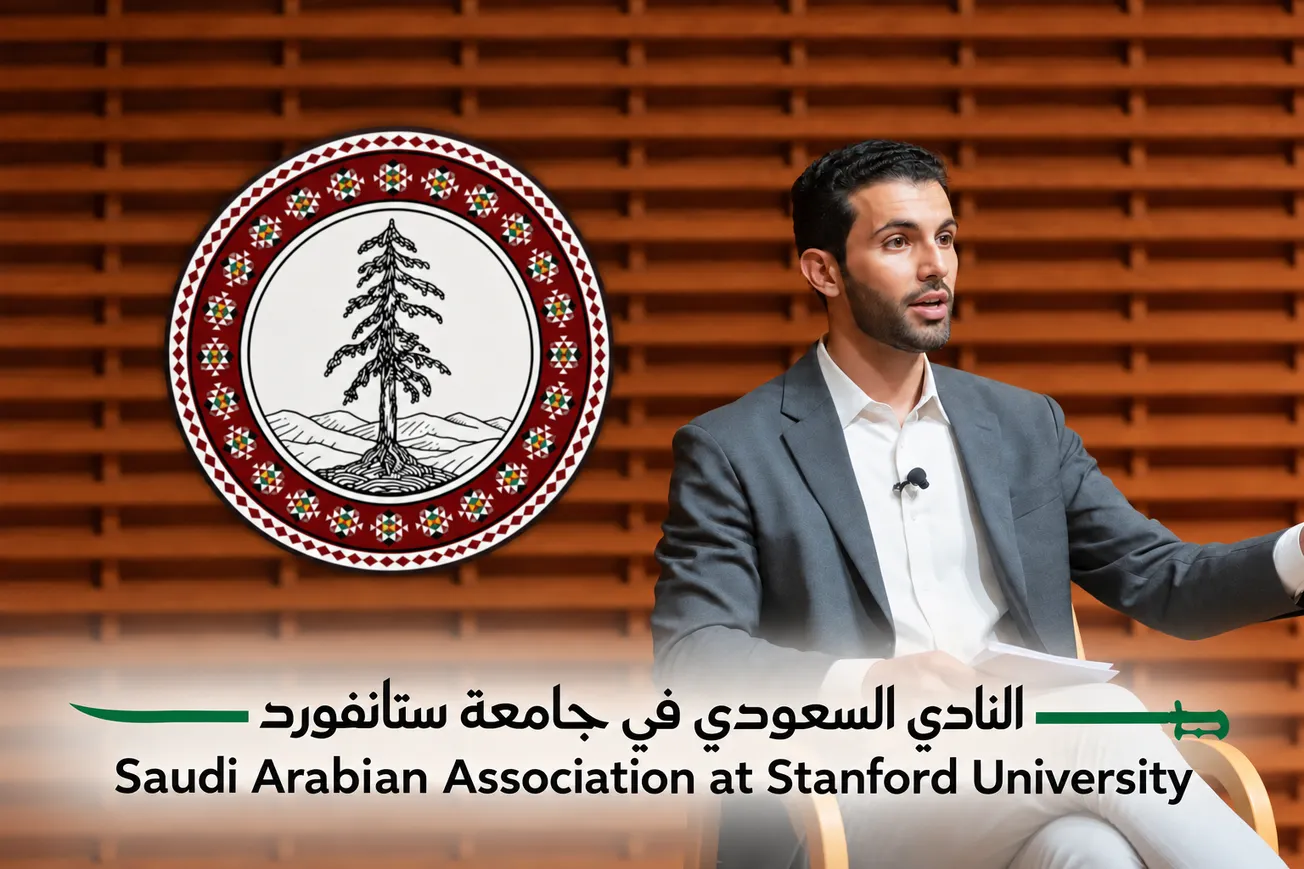
- The Saudi Arabian Association at Stanford, a recognized student group, has extensive, documented ties to Abdulrahman Alfozan, the 35-year-old Saudi national and OpenAI engineer who was arrested last Friday and accused of bugging an executive conference room at the company.
- In three public posts beginning in March 2025, student leaders of the club thanked Alfozan for his “generous support” and “backing” of the club. “None of this would have been possible without the incredible support of our community and friends,” one wrote, tagging Alfozan. The club denies that any financial contributions were received.
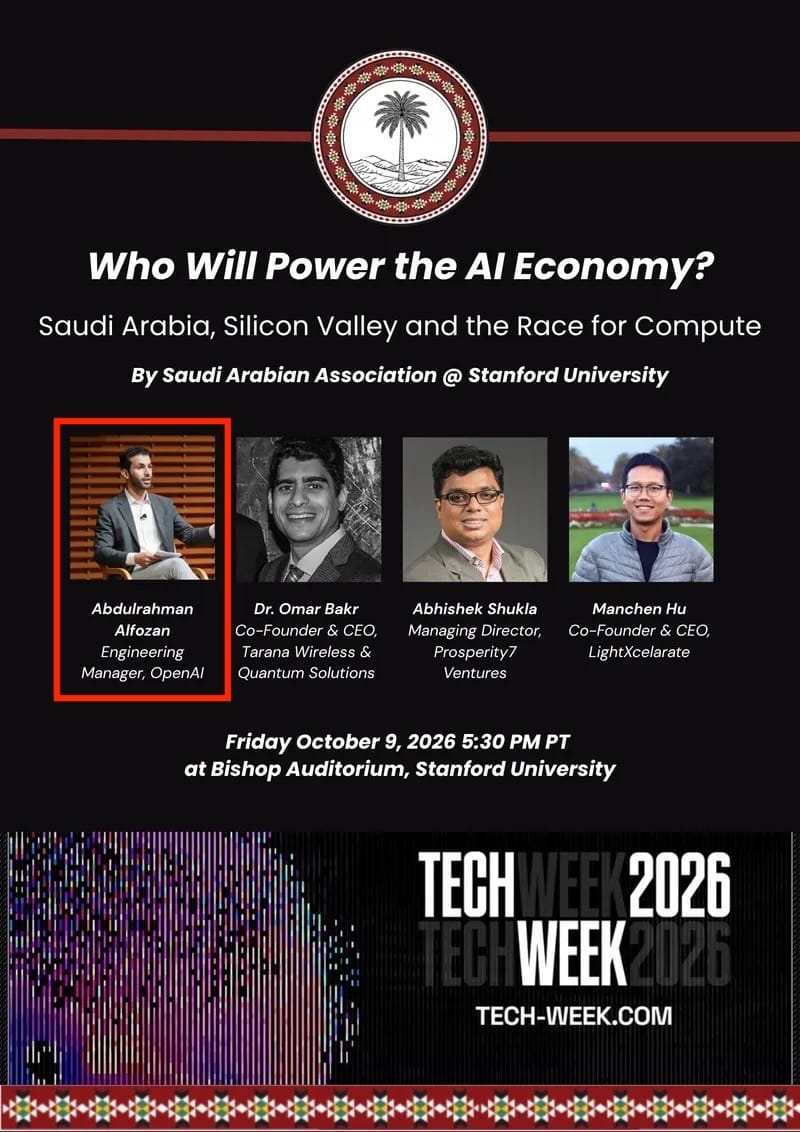
- The Saudi Association at Stanford hosted Alfozan on campus at least once, as a panelist at the Graduate School of Business in October 2025. On the day of his arrest, he was scheduled to speak at another of the club’s events about Saudi Arabia’s role in the AI economy.
- Alfozan has his own connections to the Saudi government and royal family. Five weeks before the first mention from the Stanford Saudi Association, Raed Ventures, a Riyadh firm whose fund drew state money, named him a venture partner. It had given the same title to Prince Khalid bin Bader Al Saud, a member of the royal family, two days earlier.
- Last month, according to the New York Times, Alfozan said on an Arabic podcast that he and other Saudi tech professionals in Silicon Valley had formed a group that advised Saudi organizations, including the kingdom’s social insurance agency.
- Much of this investigation is based on primary-source material independently acquired and analyzed by the Review.
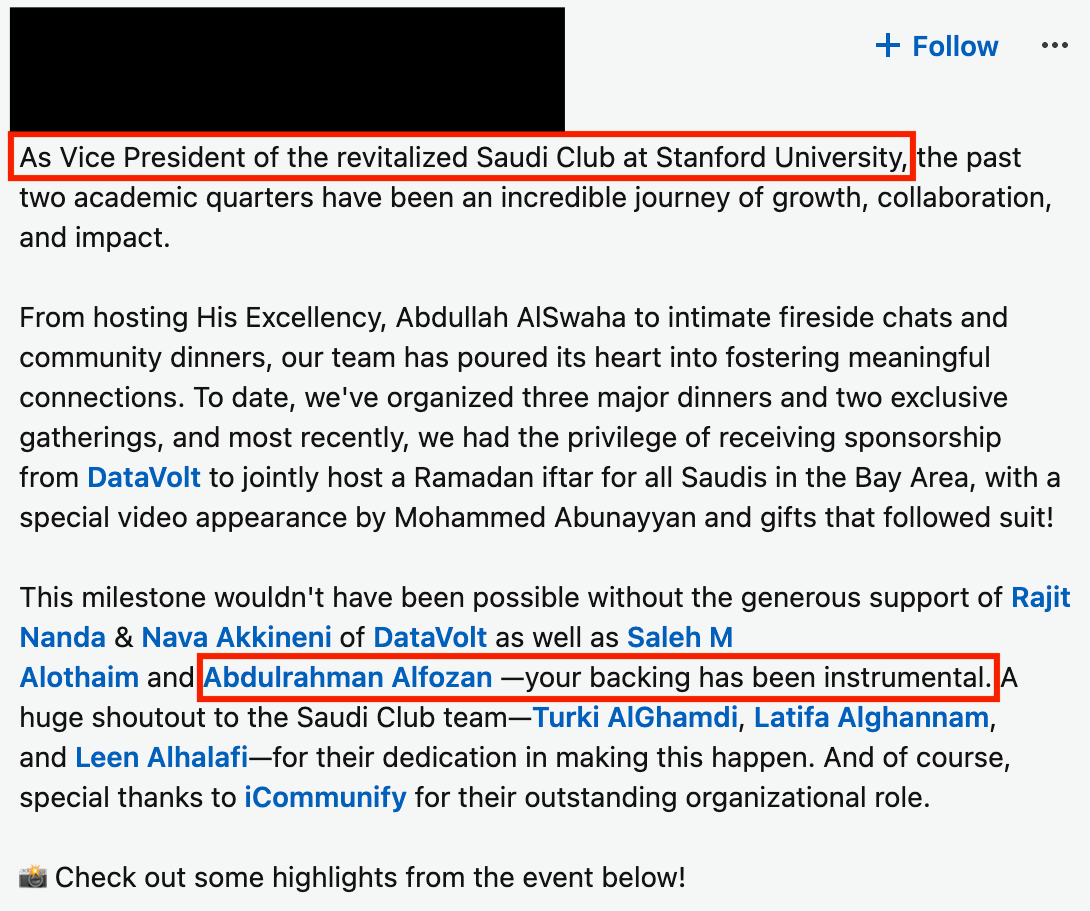
The first evidence of a relationship between the Saudi Arabian Association at Stanford and Alfozan came in March 2025, when the club’s then vice president, posted about a Ramadan iftar hosted by the club. “This milestone wouldn’t have been possible without the generous support of [...] Abdulrahman Alfozan,” wrote the vice president. “[Y]our backing has been instrumental,” he continued.
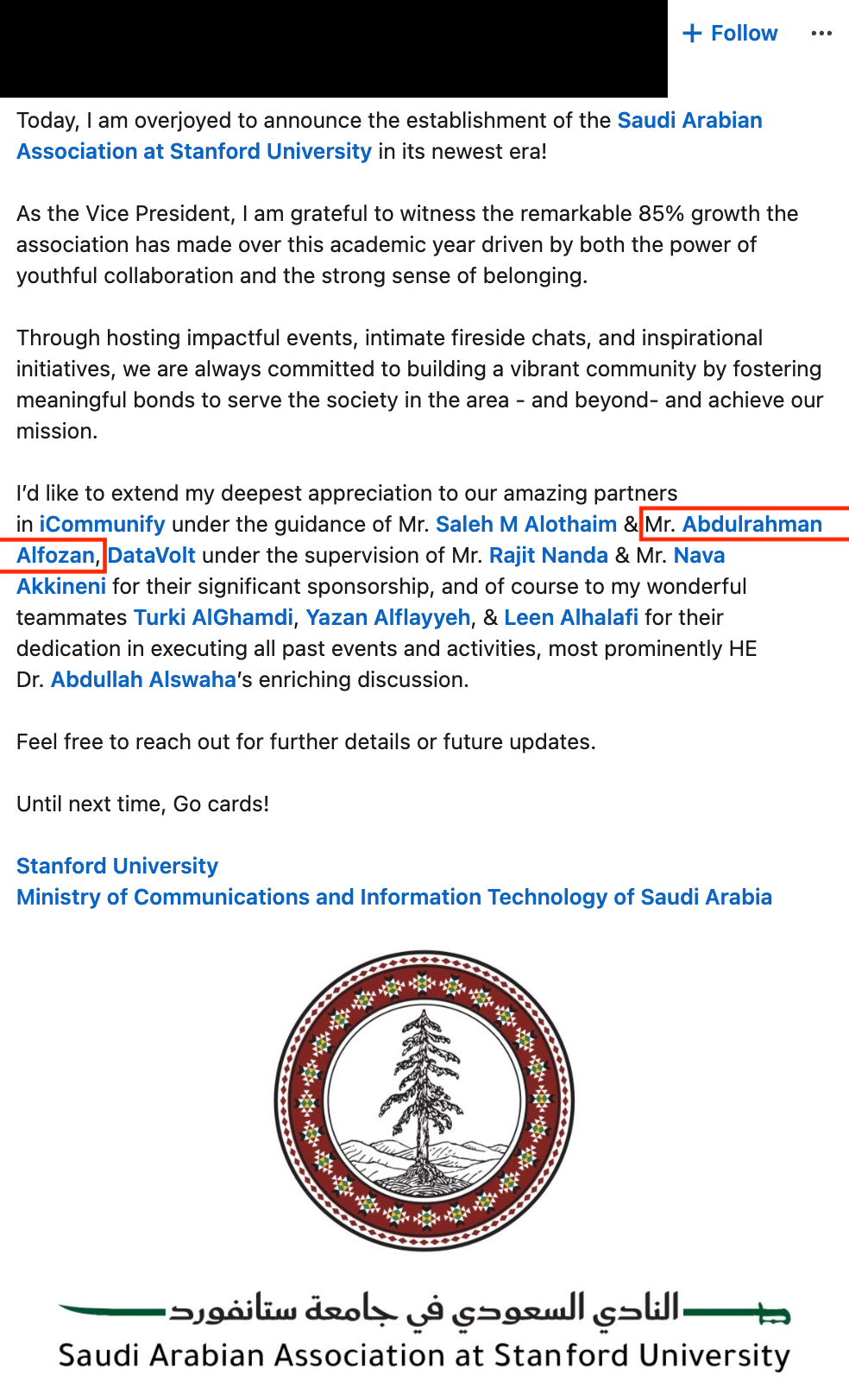
A month later, the club’s vice president, thanked “our amazing partners in iCommunify under the guidance of Mr. Saleh M Alothaim & Mr. Abdulrahman Alfozan.” The same post tagged Saudi Arabia’s Ministry of Communications and Information Technology and celebrated the club’s February event with the minister himself, Abdullah Alswaha, whose Stanford lecture was covered by Saudi state media.
iCommunify is a Palo Alto startup whose free app runs student clubs’ member rolls, RSVPs, and event check-ins. In March, the Saudi Association had credited iCommunify with an “outstanding organizational role” at its iftar. iCommunify’s app-store listings give a corporate address in Millbrae, the small suburb where, according to the Justice Department, Alfozan lives.
The career fair iCommunify now promotes on its homepage is open to Saudi students and is “backed by iCommunify’s community of Saudi student clubs and the Saudi Cultural Mission’s network.” The Saudi Arabian Cultural Mission in the United States is a government agency serving Saudis studying in the country.
Stanford’s club is not its only Saudi partner, either. At Boston University, the Saudi Cultural Club thanked iCommunify for “giving ours a place to discover and register for the Future Saudi Leaders Forum,” in a year-end post that also thanked the Saudi government’s Digital Government Authority, Aramco, and Misk, Crown Prince Mohammed bin Salman’s foundation. The club’s incoming president separately thanked “iCommunify for their continued trust and support.”
There is no evidence that the Saudi government directs iCommunify. Still, by its own count, the app serves fewer than 2,500 students, and its flagship event narrows that audience to a single nationality. That is highly unusual for a startup motivated by profit. Its own marketing presents it as a coordinating platform for Saudi student clubs in America, one that leans on the Saudi government’s network.
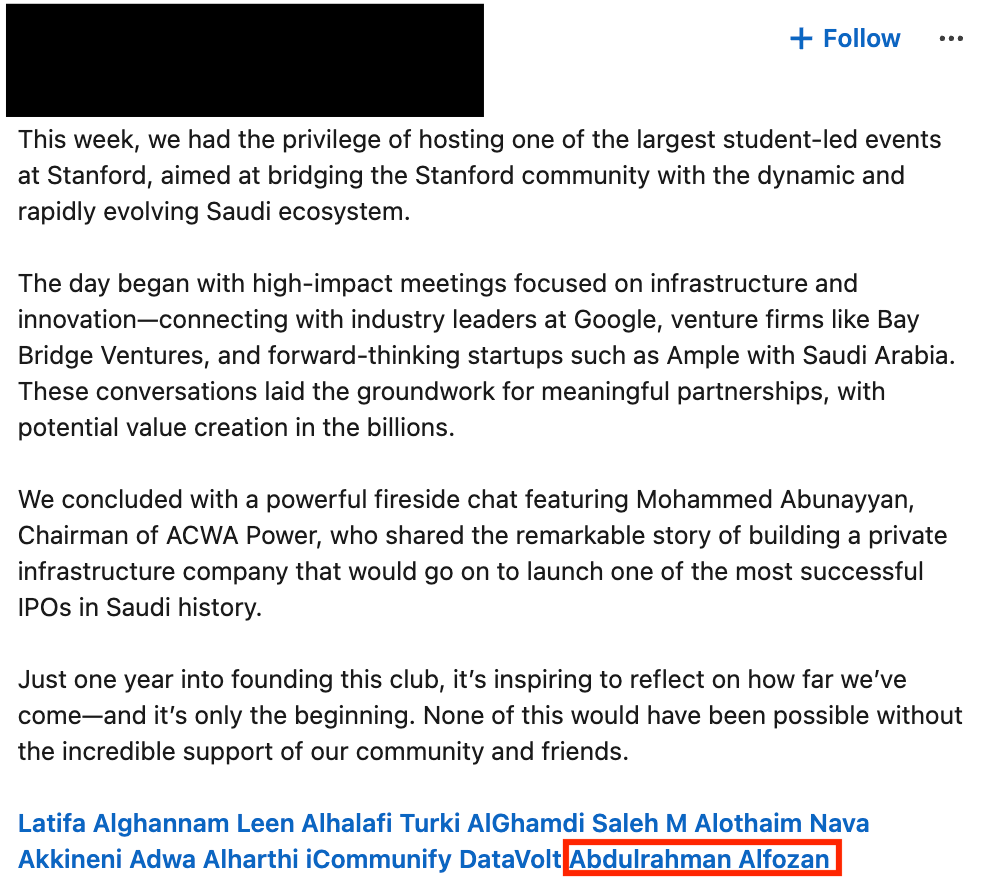
The following month, the Stanford club’s vice president described hosting “one of the largest student-led events at Stanford,” aimed at “bridging the Stanford community with the dynamic and rapidly evolving Saudi ecosystem.” “None of this would have been possible without the incredible support of our community and friends,” he added, tagging Alfozan directly. The event was covered by Saudi state media.
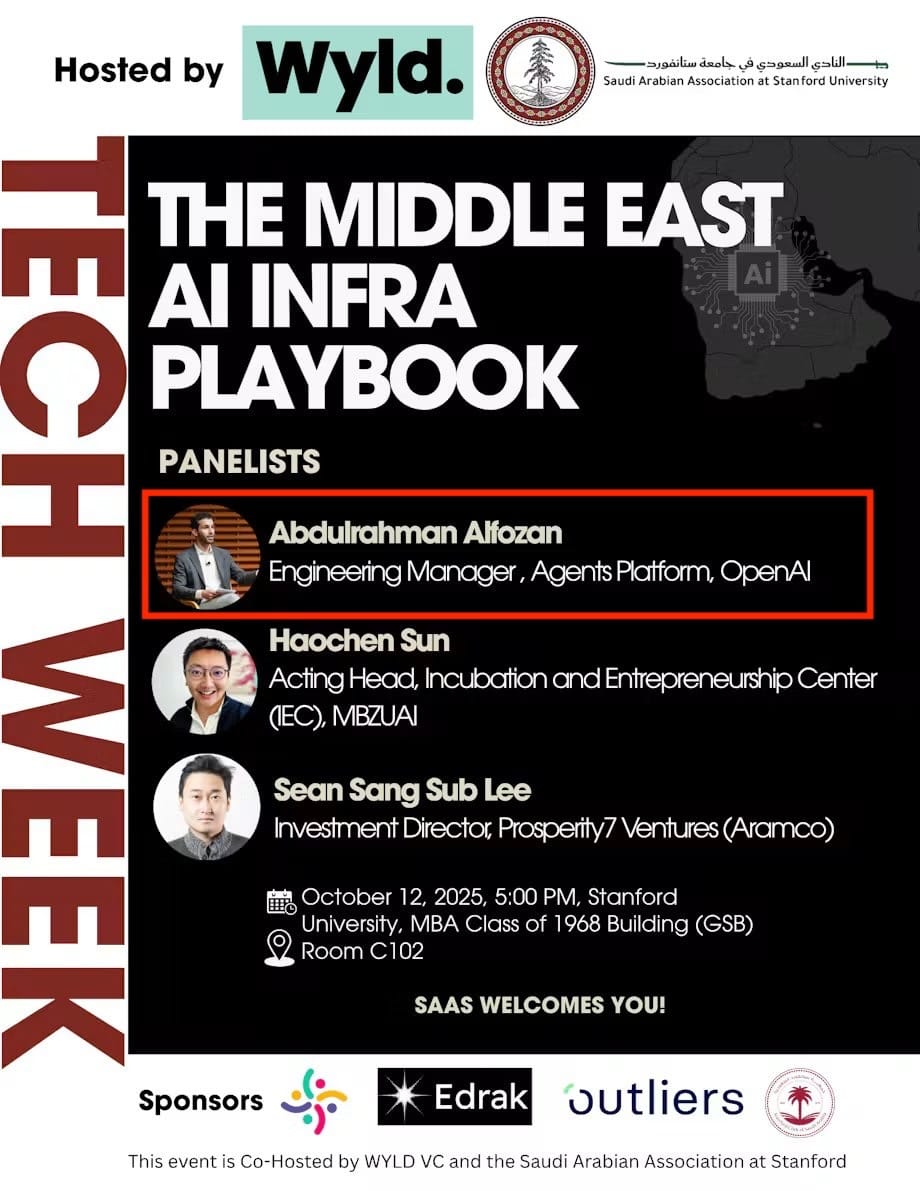
That fall, Alfozan returned to the Stanford Saudi Association as a speaker. In October 2025, the Association hosted him on a panel titled “The Middle East AI Infra Playbook,” held at the Graduate School of Business. The flyer described him as “Engineering Manager, Agents Platform, OpenAI”; he had joined the company that July. The event’s now-deleted Partiful promised to “examine whether the Middle East’s AI infrastructure initiatives present a win for U.S. tech or a challenge to its dominance.” Another panelist was Sean Sang Sub Lee of Prosperity7 Ventures, a fund of Saudi Aramco’s venture arm.
A representative of the Saudi Arabian Association responded to a request for comment stating, “[Alfozan’s] support, as well as other sponsors, are generally nonfinancial, including helping us connect with speakers, organise events and give students opportunities.’’ The representative also provided a history of the clubs’ financial transactions to clarify that no financial contributions from Alfozan occurred.
Alfozan’s own connection to Stanford goes back much further. On June 21, 2011, he posted: “1st day at Stanford. Clearly entrepreneurship is an intrinsic character within the campus.”
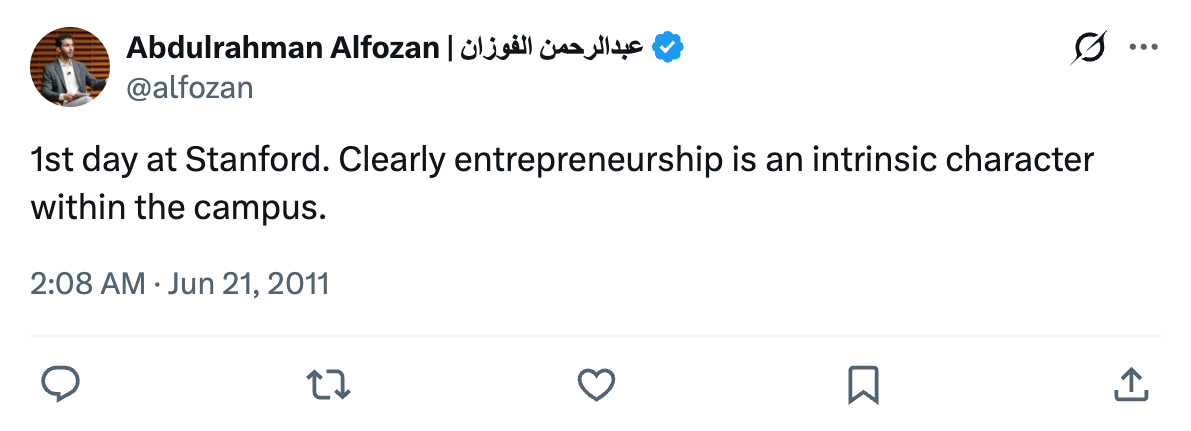
Alfozan enrolled as a student that summer, before ultimately matriculating at MIT, according to Larry Chiang, a guest lecturer for ENGR 145, Technology Entrepreneurship, and a StartX cofounder. The Review interviewed Chiang on the topic.
Alfozan took the course while at Stanford and formed a relationship with Chiang, who livestreamed his interview with a Review journalist (the author) on his YouTube channel and called Alfozan “definitely a standout” student who “sat in the front row.”
The two stayed in touch. In July 2012, when Alfozan posted that he was attending a Boston tech meetup, Chiang replied: “u miss #ENGR145 don’t u?!” Alfozan answered: “I absolutely do.”
Chiang still stands by Alfozan. After hearing the allegations from the author, he said he feels the case is “prosecutorial misconduct.” Later, in a text message to the author, he wrote: “I see Abdul Alfozan as a high character member of the MIT community and a valued alumni [sic] of the #ENGR145 class at Stanford.”
Prosecutors see it differently. Alfozan has not been charged with espionage for a foreign government, but Craig Missakian, the U.S. Attorney for the Northern District of California, called the case “a matter of national security.”
Foreign influence at Stanford is not a novel concern. The Review previously reported on a Chinese agent posing as a Stanford student and millions in Chinese state-linked donations. Saudi Arabia has a sizable footprint of its own. On the day Alfozan was slated to speak at Bishop Auditorium, The Stanford Daily reported that Saudi Arabia accounts for $43.3 million in government-linked awards to Stanford, the most of any foreign government and more than a third of the university’s government-linked total. Saudi Aramco, whose Prosperity7 fund was advertised on both Saudi Association events featuring Alfozan, has made $23.68 million in reported contributions.
The uncovering of these facts warrants further investigation. Why did the defendant, a foreign national accused of spying, provide what student leaders described as “guidance,” “generous support,” and “backing” to a Stanford student group? What did that involvement entail? The Saudi Association’s extensive ties to Alfozan raise legitimate questions about the nature and extent of his influence, involvement, and intentions at Stanford.
Author’s Note
This investigation draws on interviews conducted by the Review and primary sources we uncovered throughout this process.
We use the term spying to mean “working for a government or other organization by secretly collecting information about enemies, targets or competitors,” not in any legal sense.
The names of involved Saudi students were removed at their request.