Table of Contents
The Political Tide Turns at Stanford
Marriage Pact, Stanford’s online matching platform, has released its aggregated data from the 2025–26 cycle, covering 4,177 submissions. Its annual questionnaire asks students about academic interests, professional ambitions, faith, preferences, and politics. Libertarian, Conservative, Republican, Apolitical, Independent, Democrat, Liberal, and Socialist are independent self-selected groupings. Throughout, groups are sorted from highest to lowest mean agreement.
The 2025–26 results show a clear political shift to the right at Stanford. Students are notably more right-wing than they were five years ago, and right-wing students are both more ambitious and more optimistic about their ability to change the world than their left-wing or centrist peers.
From Fall 2020 to Fall 2025:
• The Right (Libertarians, Conservatives, and Republicans) nearly doubled, from 6.9% to 12.1% of the student body.
• Socialists and Communists were roughly cut in half, from 10.7% to 5.0%.
• The broader Left coalition (Communist, Socialist, Liberal, Democrat) declined only slightly, from 70.6% to 67.3%.
• The middle (Independent, Apolitical, Other) edged down from 22.4% to 20.7%.
CHART 1 — Political Identification at Stanford, Fall 2020 → Fall 2025
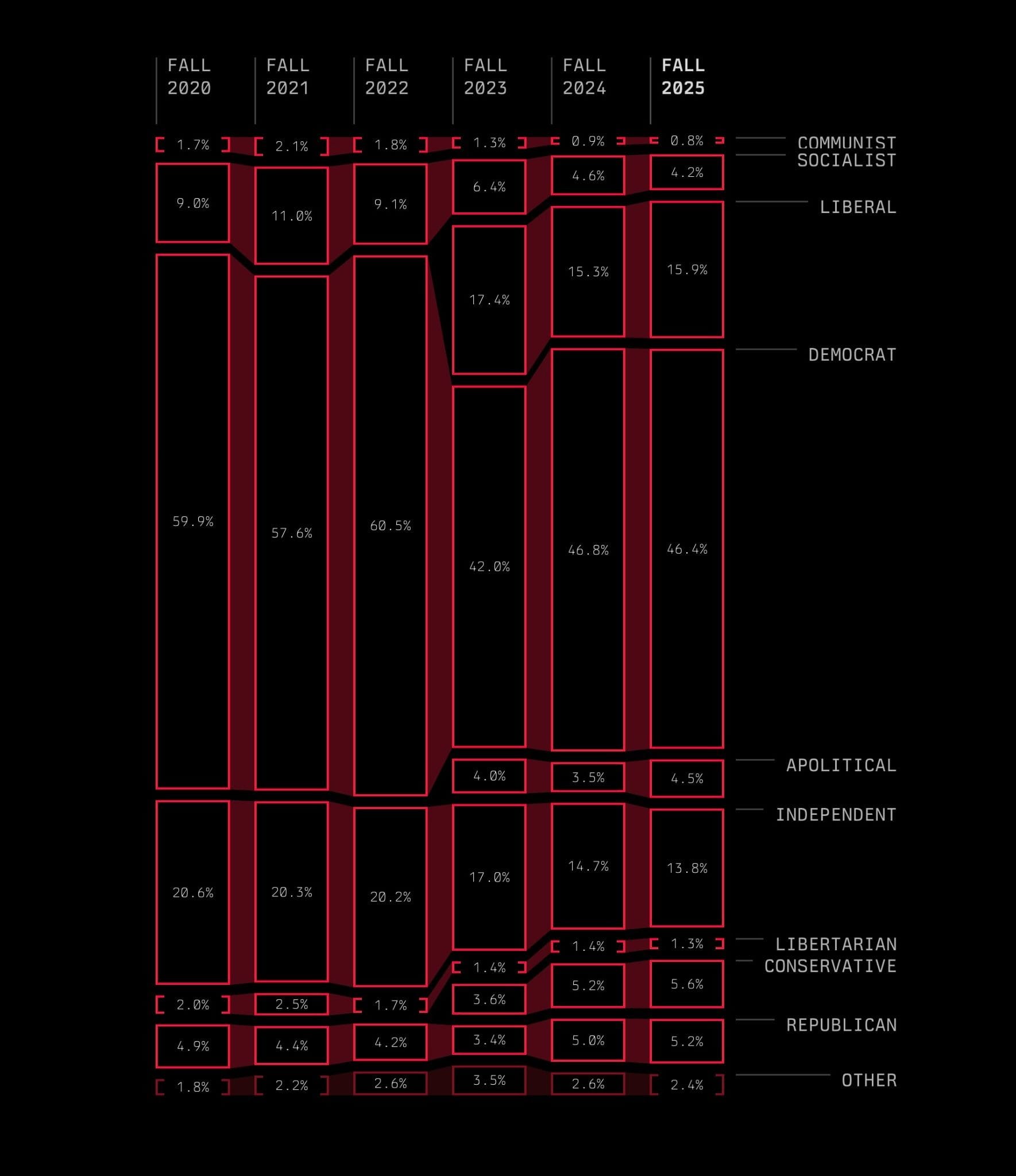
The biggest jump on the right and the biggest dip on the left both occurred between the 2023–24 and 2024–25 cycles. This past year saw a continuation of that trend rather than a regression to the mean.
Within the left, socialists declined from a peak of 11.0% to 4.2%. The Democratic Party’s growing identification with the Democratic Socialists of America may have shifted socialist support toward Democrats, with moderates following one rung over to liberals. The rough doubling of the right may also explain the growing vibrancy of Stanford’s right-wing subculture.
“I want to be part of the 1%.”
Just as significant as the change in the number of conservatives is the type of conservatives now at Stanford.
CHART 2 — “I want to be part of the 1%.”
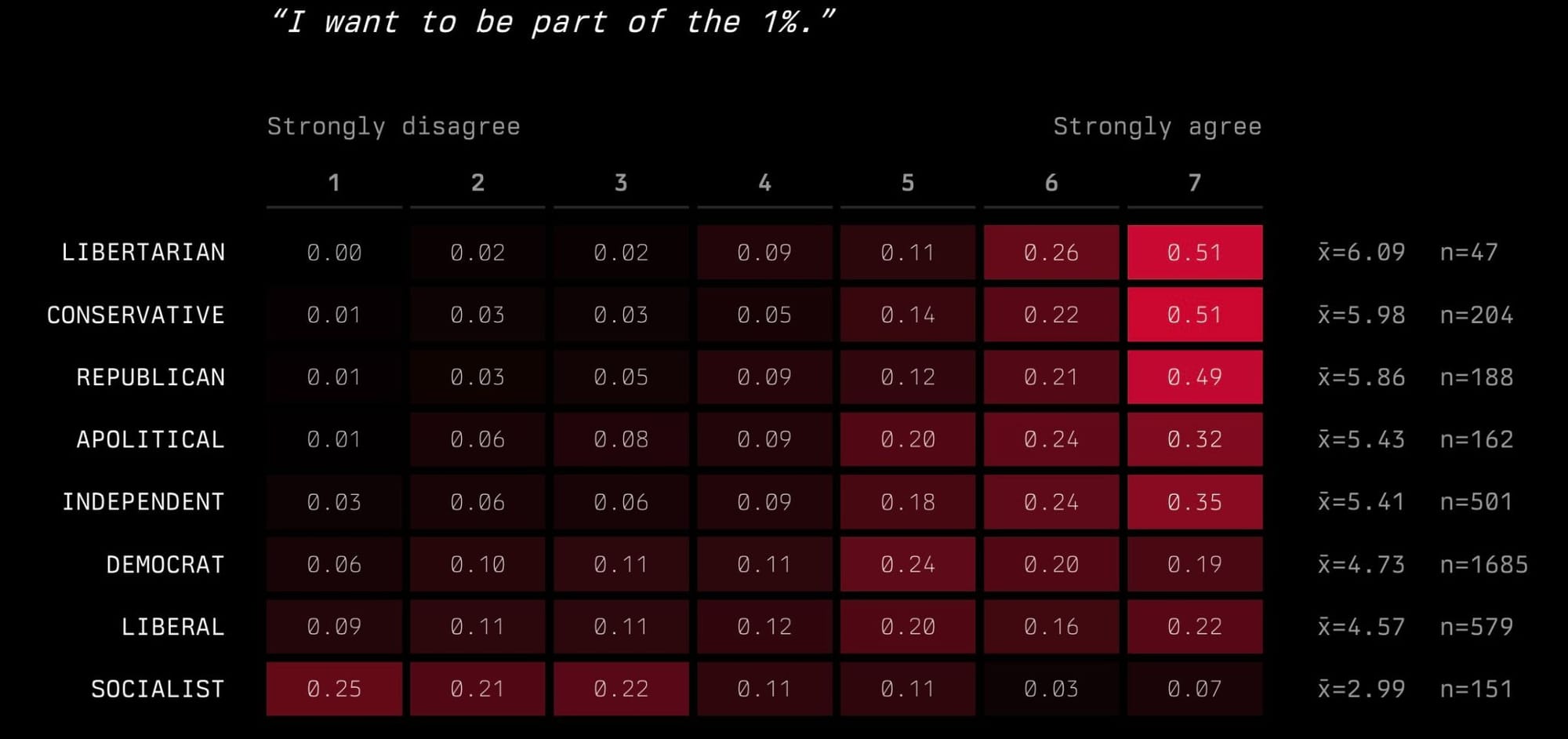
Half of right-wing students (50%) selected the highest category of agreement — strongly agree — with the statement “I want to be part of the 1%.” Only 16% of left-wing students did the same. Overall, 86% of right-wing students agreed with the statement, compared with 47% of left-wing students. That left-wing figure is dragged down in particular by socialists, only 21% of whom agreed.
The question is open-ended and does not specify whether the “1%” refers to net worth, prestige, or professional success. Statistically, right-wing students are considerably more ambitious than their left-wing peers.
“I believe I can truly change the world.”
Conservatives responded most positively to the question of their ability to change the world. Republicans ranked last, closely followed by socialists, the apolitical, and Democrats.
CHART 3 — “I believe I can truly change the world.”
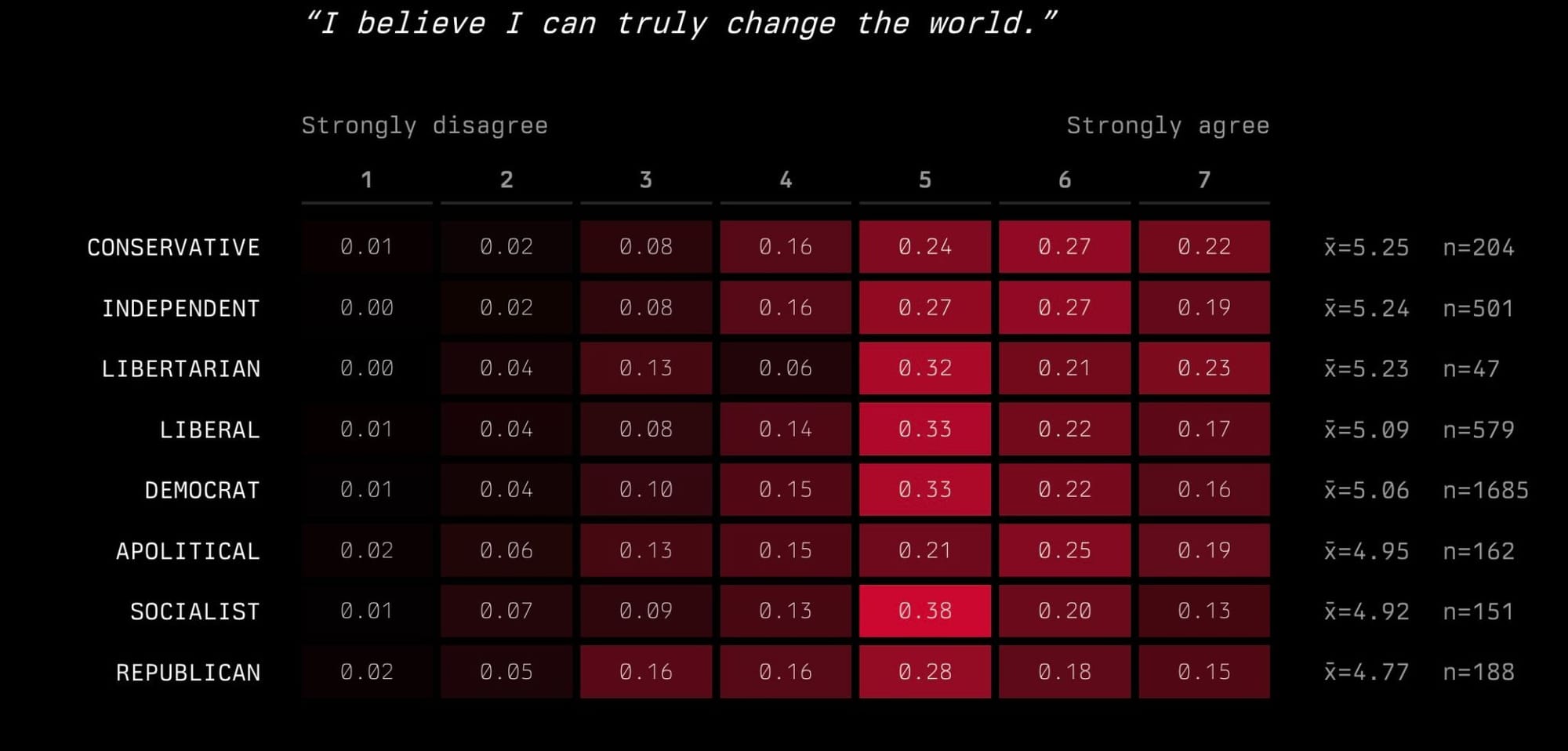
It is no surprise that Stanford Democrats feel disempowered as of late. However, the sharp divide between Republicans and Conservatives is notable. While students are ultimately becoming more right-wing, fewer want to associate with the Republican Party.
Conservatives, ironically, are more interested in changing institutions than any other group, even so-called progressive ones.
Stanford is shedding the left-wing dominance that defined the Covid era. What remains to be seen is whether this means long-term change for Stanford’s campus, and whether it can extend to the elite of Silicon Valley and the United States as a whole.