Table of Contents
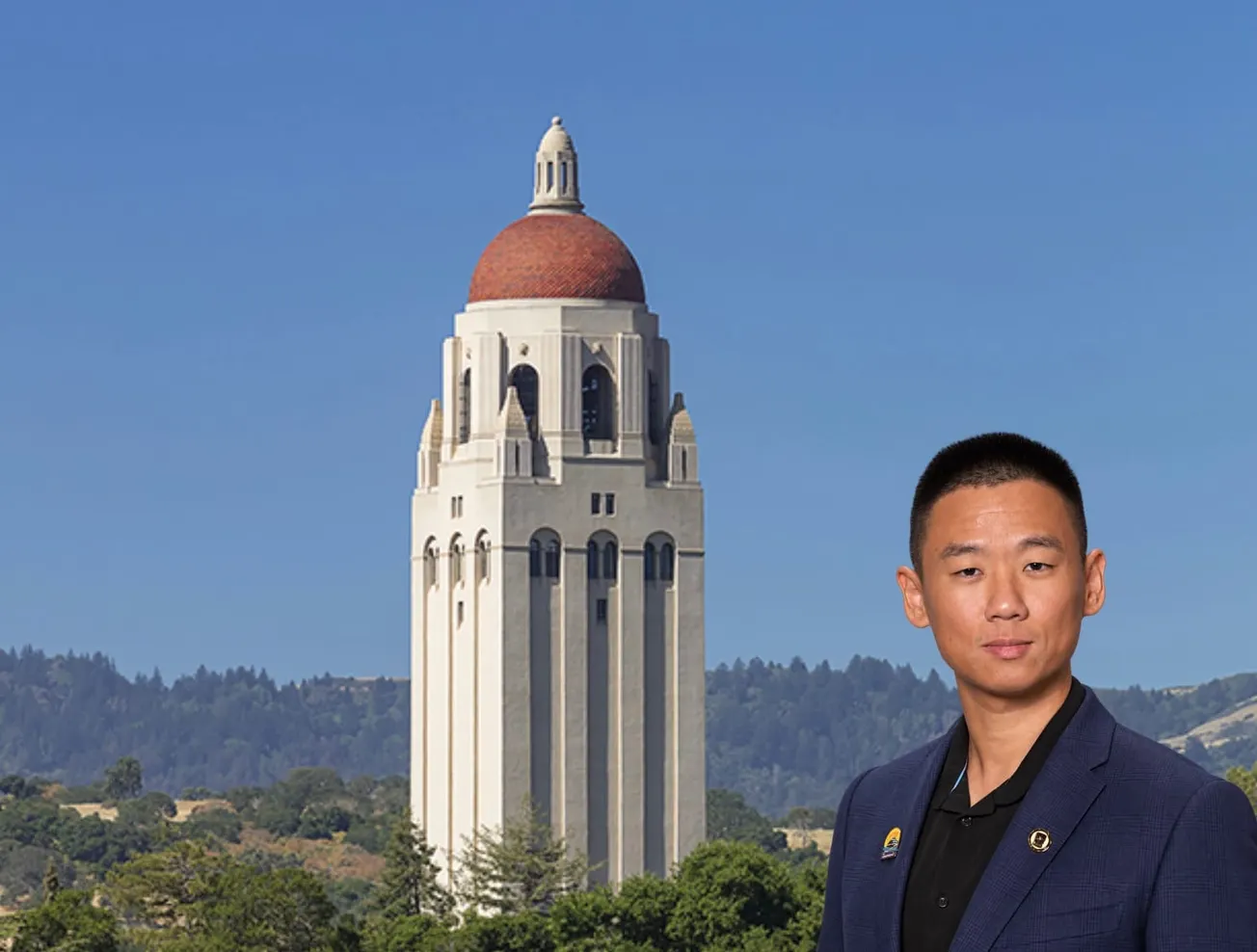
Apoorv Agrawal is a Partner at Altimeter Capital, where he leads the firm’s investments in artificial intelligence and software. He has backed some of the defining companies of the AI supercycle, including OpenAI, Glean, Revolut, and Baseten. Raised between India and Singapore, Agrawal holds a degree in Computer Science from the National University of Singapore and an MBA from Stanford.
This quarter, Agrawal is teaching MS&E 435: Economics of the AI Supercycle, a seminar that unpacks the economics at each layer of the AI stack, bringing in industry leaders including Ali Ghodsi of Databricks, Brad Gerstner of Altimeter, and Chase Lochmiller of Crusoe.
This conversation follows Agrawal as he maps the AI supercycle and describes how value capture will shift from semiconductors to applications. Throughout, Apoorv returns to the guiding principle that has carried him from a small town in Uttar Pradesh, India to the front lines of venture capital: follow the smartest people in the room.
The following interview was lightly edited for length and clarity.
Jack Murawczyk: Born in India to two doctors, a government scholarship to Singapore at sixteen, four years of engineering at Palantir, an MBA at Stanford, and now leading AI investing at Altimeter. What’s the throughline?
Apoorv Agrawal: I wish I could tell you that I had a plan. I did not. As Steve Jobs said, “You can’t connect the dots looking forward; you can only connect them looking backward.”
I realized that I kept moving towards people smarter and more talented than I was. That’s still the strategy: to keep finding myself in rooms where I’m the least qualified person.
I was born to a humble family that really valued education. My parents were the first of their generation to attend college; they were postdocs when they had me. So I was raised by my grandparents in a small town called Orai, and moved in with my parents when they finished their education.
I grew up like most kids, trying to figure out my way in life. One day, I saw an advertisement in the newspaper for a scholarship to Singapore. The Singapore government advertised the scholarship across the ASEAN countries. They took about a dozen kids every year. I worked hard, but when there were that many people and that many rounds of testing, there was a huge element of luck.
And so I moved to Singapore on this great scholarship and promptly failed my English exams! I ended up spending most of my two years of high school in Singapore working on reading, writing, Toastmasters, and debate. I learned to communicate, which is the passing and dribbling of business.
I got another scholarship from the Singapore government to come to Stanford. I would have gone to grad school after undergrad had the smartest people in my class not told me about Palantir. Palantir gave me a mission that was larger than my own life, my compensation, or my 11th hour of sleep: to save the West. That mission defined the next phase of my career.
JM: From a scholarship student moving through Singapore to a venture leader shaping the future of American industry – what was the vision of America you held when you first arrived, and how do you think about it today?
AA: When I first came to the US in 2011, I saw it as a place where ambitious people from anywhere could come work on the most important problems. I was in a state of awe.
It was as if the lid came off the top: I was studying at Stanford; I rented a garage in Redwood Shores for $200 a month; I interned part-time at a machine learning research lab called Rocket Fuel; I started a business called Fresh Mentors; I was trading cars. I was working harder than ever because I saw opportunity everywhere.
Today, I have a more nuanced view. America is not automatic. The life that you and I see here: Stanford, Silicon Valley, Palantir, the AI supercycle – these are not normal ecosystems. They exist because America has historically combined talent, capital, risk tolerance, universities, and immigration. Silicon Valley is one of the few parts of the US with this special alchemy.
I became a US citizen four years ago. As an immigrant, I feel intensely American because I’m actively making a choice to live 16 hours away from my parents and to dedicate myself to the pursuit of excellence. There are real trade-offs that come with it, and it has helped me clarify my own missions in life.
JM: If you were a student applying the principle of following the smartest people in the room, where would that lead you today?
AA: That question addresses what I tried to create with MS&E 435: Economics of the AI Supercycle.
I wish that there were a class like MS&E 435 when I was in undergrad. I was a nerdy engineer then, trying to figure out what I was going to do with my life. I got super lucky that I found Palantir. But the surface area of luck can be extended if you hang out with the smartest people – a Singaporean friend of mine, Jamie Long, referred me to Palantir.
Yash Patil, who spoke in class last Thursday, has done a great job of bringing smart people to Applied Compute. So I asked him, “What other places are you competing with for talent?” Of course, it’s OpenAI and Anthropic. Then there are the applied labs: Vercel, Cognition, Cursor, etc. There’s also a buildout of the semiconductor complex – I’d put the Etched team up there.
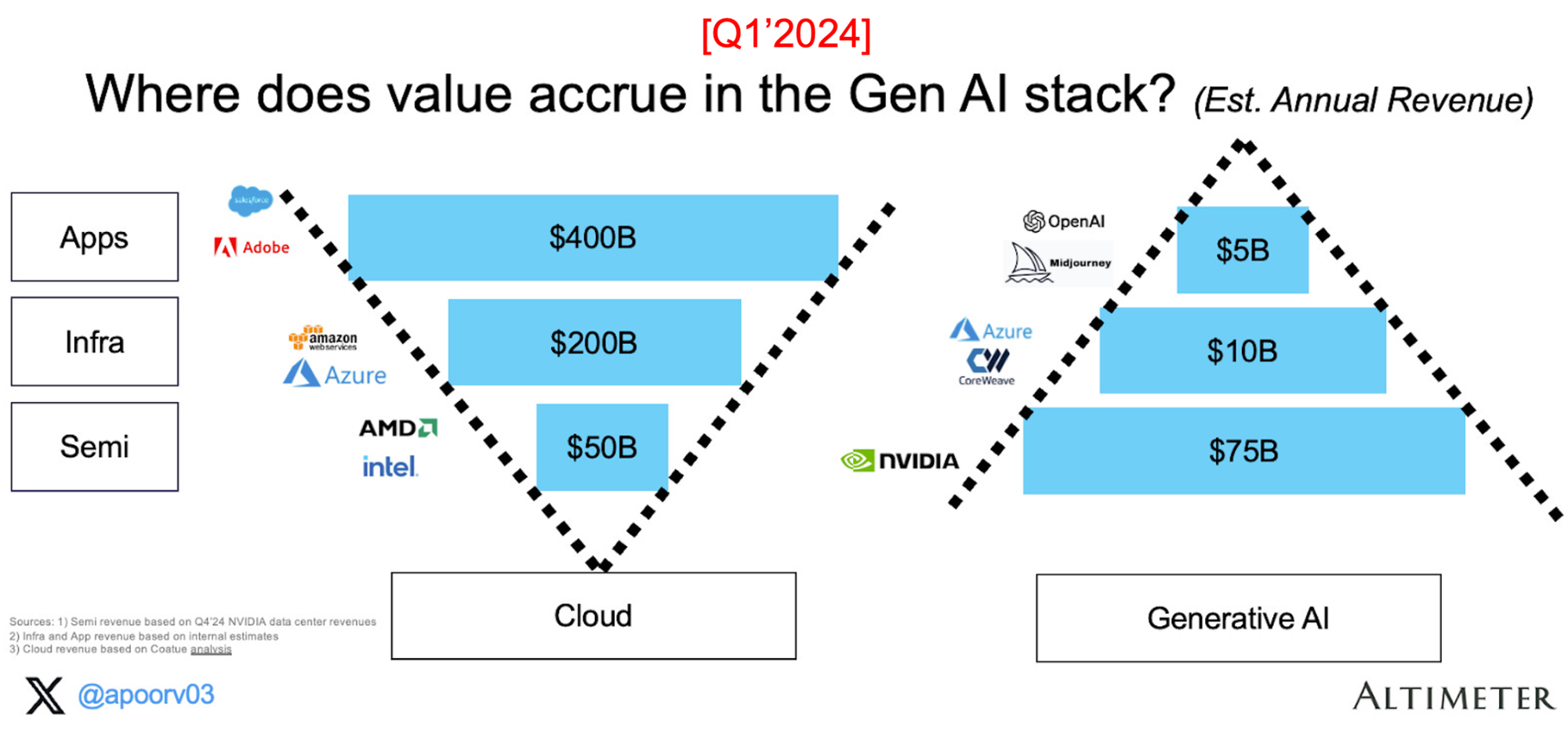
JM: You’ve written about the AI stack being inverted. Unlike with cloud and other tech revolutions, the vast majority of top-line growth has gone to the bottom layer of the stack. You believe this will change. Why?
AA: Every meaningful supercycle has had a version of inversion. Historically, the first inning is laying the railroads. Eventually, the question becomes “what are the best ideas that will endure?”
Many early internet ideas had a short half-life. But the things that survived were ideas that sound funny in hindsight: Brian Chesky started Airbnb for mattress rental on the internet; YouTube started as a dating website called Tune In, Hook Up; Amazon was an online bookstore.
There’s an idea of skeuomorphism: we are still trying to map a new technology onto an old workflow. The most durable ideas for the AI supercycle might not even have been born yet!
I can understand why it’s hard to imagine the reversal of value capture, but I’m convinced it’ll happen because it’s happened in every supercycle. History rhymes.
The model layer is expanding rapidly today. Anthropic is rumored to be at a $45 billion run rate. OpenAI is rumored to be at $30 billion. Gemini is somewhere at $5-10 billion. So the stack is $300 billion at the semi layer, $150 billion at the infra layer, and $100 billion at the apps layer. But look at the growth rates! The triangle, if I drew the chart next year, might be a rectangle, and ultimately will invert.
JM: What are the indications that this will shift? Right now, H100 prices are going up, not down.
AA: The price of the H100 is going up, true – but what you’re renting is more than just the chip. You get the land, the powered shell, the energy, the networking, the compute, the cooling, all of it packaged into three dollars an hour. So the surge in H100 prices isn’t driven by the chip itself.
I love the electricity utility analogy: In 2000, getting internet felt like a workout. You had a dial-up modem, and you’d sometimes get booted off if somebody made a phone call. That’s what getting a GPU feels like right now. I fully expect that in X years, it’ll be as easy as connecting to WiFi in 2026.
JM: Ben Thompson calls advertising the “most important business model in tech.” But ChatGPT lacks the dopamine loop of TikTok or the network effects of Instagram, and it’s hard to imagine subscription pricing alone extracting enough consumer surplus to justify current valuations. So how do companies actually monetize the top of the stack at the scale required?
AA: We are so early in the AI supercycle that while we understand AI today to be ChatGPT, Gemini, and Claude, there’s more to come.
Product-market fit for knowledge workers is obvious. These products aren’t showing you cat videos, you’re not scrolling through them with joy, so you have to be doing active work to use these tools. But how many of the 8 billion people on the planet are knowledge workers?
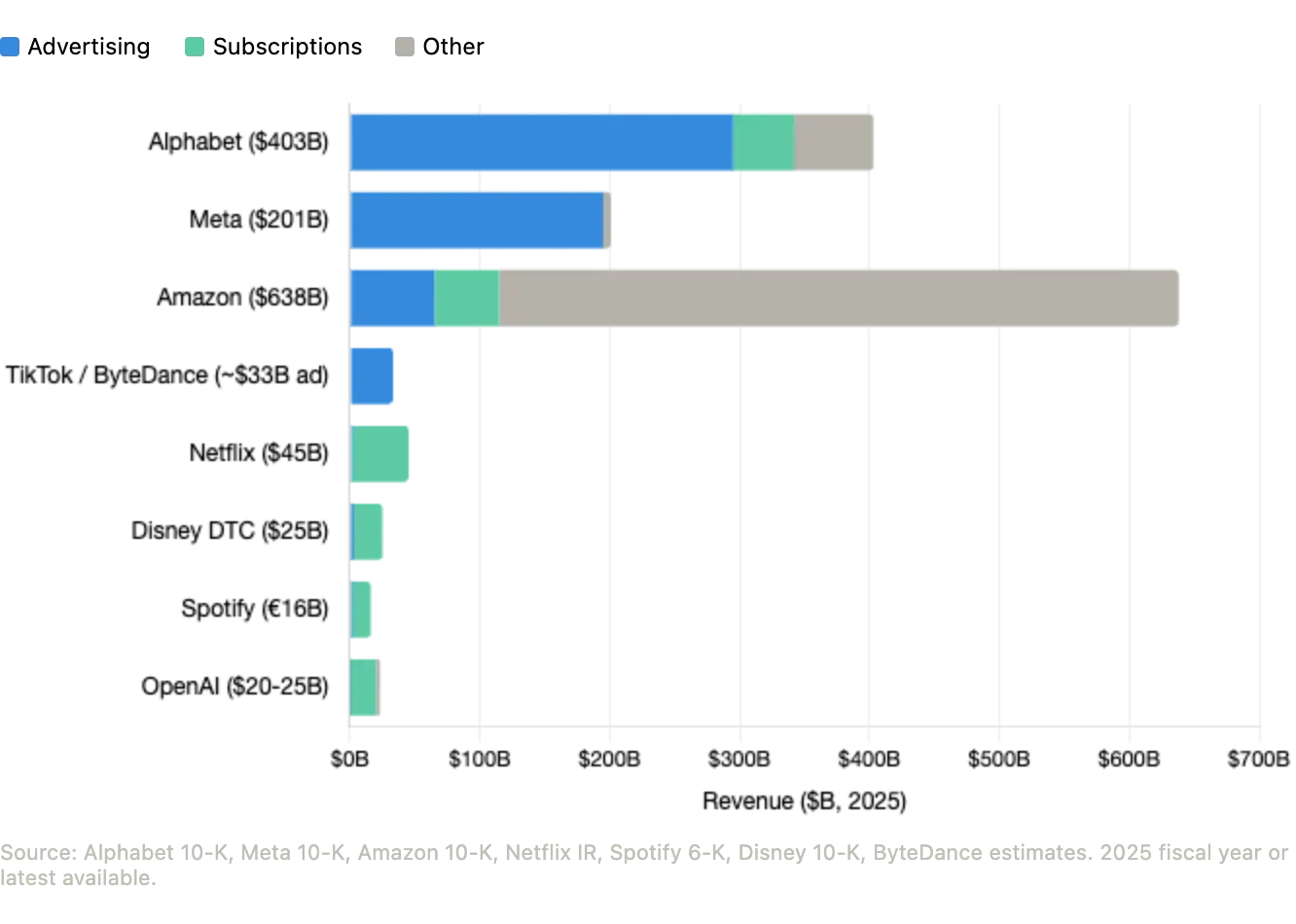
Let’s go through the PxQ (Price x Quantity) math on advertising. Alphabet has about 4 billion users across the world, monetized at $90-100 per user per year through advertising predominantly. Meta has 3.5 billion users, monetized at about $60 per user per year. ChatGPT has about a billion weekly active users, only 5% of which is monetized for a blended rate of about $12-15 per user per year.
Yet the advertising business model could end up being larger than the subscription franchise. Why?
First, you have near-perfect information based on login data. Second, you have incredibly high intent. Third, advertising franchises are traditionally larger than consumer franchises. The pure-play subscription businesses are actually not that large. So advertising is a large opportunity, and one I suspect all the leading labs will pursue.
JM: Can we dig a little more into advertising? There seem to be two approaches ChatGPT could take: Instagram, where a rich profile is built of your preferences over time, and Google, where you searched for couches, so you are shown couches. And does the second approach compromise the integrity of the generated response?
AA: Great question. Advertising revenue is a function of three things: time, ad volume, and pricing. Time is the total time you have from users – a function of the number of users and how much time they spend on the app. Ad volume is a publisher’s decision: if you have somebody on the platform for one hour, what percentage are ads? Pricing is a conversation with the demand side. How valuable is this ad? How do I decide which ad to show?
That’s what I was doing in my first job at Rocket Fuel: ad targeting. Today, the modern internet advertising operates on the Dutch auction.
One thing that is underappreciated is if there’s a new ad format that might be born here. If you remember the Meta IPO over a decade ago, people were concerned that the phone was a small screen – where are you even going to put an ad? It turns out we figured that out.
Something that escapes the present-day SKUs could be one of the reasons the CPMs could be higher. But it’s still too early to say.
JM: Where do you most sharply disagree with the consensus among AI investors right now?
AA: One of the dominant narratives in the public markets is that anytime the large labs launch a product, there’s a series of startups, incumbents, and software businesses whose valuations are destroyed. Anthropic and OpenAI are eating the world.
This narrative is incorrect, exemplified by how the presence of iMessage on the Apple platform did not obviate the success of WhatsApp. The fact that OpenAI or Anthropic might build an app doesn’t obviate the success of a design tool or a coding tool. It just raises the bar.
The biggest challenge for successful products is not intelligence, which OpenAI and Anthropic deliver in spades. In consumer, the biggest race is to capture most of the context of your day-to-day life: your vision, your speech, your audio, your sense of touch, your sense of smell.
Unfortunately, there is no good benchmark that measures context. If there was a benchmark that measured context – let’s call it “Data Under Management” – that would be the killer benchmark to hill climb on. As I look at new products or new ideas, the ones that excite me most are focused on the body, not the mind. The mind is the intelligence layer. The body is the hardware layer: the vision sensors, the audio sensors.
JM: China’s AI ecosystem (DeepSeek, Qwen, Kimi…) is producing surprisingly capable open models at a fraction of frontier-lab capital expenditures. Is this open-source convergence a deflationary force that compresses returns at the model layer, an accelerant for the application layer, or something else?
AA: In one word, expansionary. These models are getting really good, and I expect the gap to the frontier will keep closing.
The emerging paradigm is to use a frontier model for planning and an open-source model for execution. Planning is a harder job; execution is lower on the intelligence index, so you could use a non-frontier model, an open-source model. Bret Taylor at Sierra talked about this: for customer service, for refunds or delivery timelines, it doesn’t have to be the smartest model.
Inference will be so pervasive in our day-to-day lives that it will have to be cheaper than it is today. Three years ago, GPT inference cost roughly $30 per million tokens. We’re now down to roughly 5 bucks.
JM: You’ve called 2026 “the Year of Liquidity,” with SpaceX, Anthropic, OpenAI, and Databricks all in the IPO queue. The reflexive comparison is the 1999-2000 IPO boom, yet SpaceX, Anthropic, and OpenAI alone are expected to match the combined market cap of every tech IPO from 1995 to 2000. How are you thinking through this unique upcoming IPO market?
AA: To put this in visceral context: US GDP is $32 trillion. The US market cap is probably $60 trillion.
AA: SpaceX is contemplating an IPO at $1.75 trillion. That is 3% of the total market cap of the country. Paul Tudor Jones said on Invest Like the Best that for the last decade or so, we’ve had a couple percentage points of supply in the equity markets being removed due to stock buybacks. That has led to appreciation of stock prices. But for the first time, we might have an expansion of equity supply. The SpaceX IPO will be the first big barometer. It’s just hard to predict how this IPO will perform.
It will lead to innovation in financial instruments that allow existing shareholders to sell. Historically, you’ve had a 6-month lockup period. Now there might be cascading lockup structures, innovations around the ability to sell while making sure the stock price is not adversely affected.
The other dynamic, which you alluded to, is the construction of indices. If you own an ETF or index, you have 2 to 3% added to the index. How do you absorb all this supply?
JM: All price-insensitive.
Moving on, what is in your personal tech stack? How do you make yourself, as Brad Gerstner put it, bionic?
AA: I gave you a hint of this, Jack… It’s all about the context.
I built something three years ago called Altimeter GPT. The daily research that we do – news, YouTube, the Twitter firehose, proprietary qualitative and quantitative data – all ingested into a lakehouse and processed using a series of techniques, including large language models, which are good at finding needles in a haystack.
Every day at 7 AM I ask: What happened in the world that I should know about? That’s where I start my day. I’m constantly thinking about how to add more context. There’s more innovation to come because 90% of my life is still going by without the context being captured.
JM: Beyond the term sheet, where do you find magic and meaning in the world?
AA: As somebody who got promoted to dad seven months ago – it is magic. Here’s the little one. Her name is Diya. In Sanskrit, it means a source of light. I’ve never fallen in love faster. It’s been truly magical. Nights are long, sleep is scarcer – it’s all worth it. It makes me appreciate the sacrifices that parents make more vividly.
JM: What’s on your nightstand right now?
AA: Bill Gurley’s Runnin’ Down a Dream. Bill is an anthropologist: he’s studied the history of venture capital like nobody else. As somebody who’s long admired and studied his work, I was thrilled when I first met him at Altimeter in January 2024. All we have to do is go read his book, which condenses decades of wisdom. Somebody ate all the veggies – I just have to drink the juice! It’s a phenomenal read.
JM: That’s funny – I just got a signed copy of it myself at Kepler’s!
What is the kindest thing anyone has ever done for you?
AA: The kindest thing – which I only appreciate now – is what my parents did, letting me leave India at the age of 16 for Singapore. They gave me freedom before I had the maturity to understand what it cost them.
The biggest gift they gave me in that moment was trust: “We trust you to live your life and expand your horizons.” It required enormous sacrifice to let their child go so far away, because they believed it would expand my life. That kind of sacrifice is hard to appreciate when you’re young. I do now. It’s when life began for me. I have huge gratitude to my parents for making that choice.